Data center capacity is growing rapidly. AI workloads, video streaming, SaaS platforms and always‑online businesses all demand more compute, storage and network throughput. At the same time, regulators, investors and customers are asking a very direct question: how sustainable is the infrastructure behind all this growth? Planning a new server hall, rack row or hosting region involves more than power and cooling capacity: carbon emissions, grid impact and long‑term efficiency also matter.
In this article, we will walk through how modern data center expansions work, what “green energy initiatives” really mean in practice and how these decisions affect the infrastructure behind your hosting, VPS, dedicated servers and colocation projects. We will stay away from buzzwords and focus on the technical and operational considerations: power usage effectiveness (PUE), renewable contracts, cooling strategies, hardware choices and network design. By the end, you will know what to look for when evaluating providers and planning infrastructure growth with sustainability in mind.
Why Data Centers Are Expanding So Fast
Capacity planning now needs to accommodate more than classic web hosting, small business email and moderate traffic e‑commerce. Important drivers of new expansions include:
- AI and machine learning workloads: GPU‑heavy clusters with very high power density per rack.
- High‑traffic SaaS and APIs: multi‑region architectures that replicate data across several locations for latency and compliance.
- Media and collaboration tools: video calls, streaming, game servers and file sync, all demanding sustained bandwidth.
- Edge and regional hosting: businesses want their websites and applications physically closer to users for lower latency.
Explore related infrastructure topics on the DCHost blog. But growth is not just about AI. Even relatively traditional workloads – WordPress, WooCommerce, corporate portals, internal business apps – are increasingly deployed in multi‑region and high‑availability topologies. That means more racks, more fiber, more power and more cooling capacity.
On top of this, cross‑border transfer rules under KVKK, GDPR and other laws can influence hosting location choices; they should not be read as blanket requirements to store all personal data domestically. Specific localization rules and business requirements can drive demand for regional facilities. If you have read our guide on choosing KVKK and GDPR‑compliant hosting between Turkey, EU and US data centers, you already know how strongly location now shapes infrastructure planning.
The Energy Problem Behind Capacity Growth
Adding racks requires power, cooling and redundancy around the clock. One facility efficiency metric is PUE (Power Usage Effectiveness), which compares total facility energy use with IT equipment energy use. It does not by itself measure financial cost or carbon emissions. In simple terms:
- PUE = Total facility energy / IT equipment energy, measured over the same period.
- A PUE of 1.0 would mean every watt goes directly into servers, storage and networking – no overhead.
- Real‑world PUE is above 1.0 and varies with design, climate, utilization and measurement period.
Expanding capacity generally increases total energy use, but does not necessarily raise PUE. PUE rises only if facility overhead grows relative to IT energy use; better utilization of existing cooling and power systems can instead lower it. Carbon emissions per workload also depend on hardware efficiency, utilization and the electricity mix.
This is where sustainability stops being an abstract marketing term and becomes a hard engineering constraint. Power contracts and grid capacity need review, and transformer and UPS paths may need redesign. Depending on the jurisdiction and project, approvals may require environmental impact assessments or efficiency reporting. Power and cooling design should therefore be treated as a core capacity decision, not a hidden back‑office detail.
What Green Energy Really Means for Modern Data Centers
“Green data center” can mean very different things depending on who is speaking. From a practical perspective, we break it down into several concrete initiatives that can be measured, audited and improved.
1. Renewable Energy Sourcing
The first question is simple: Where does the electricity come from? Many modern facilities use a mix of:
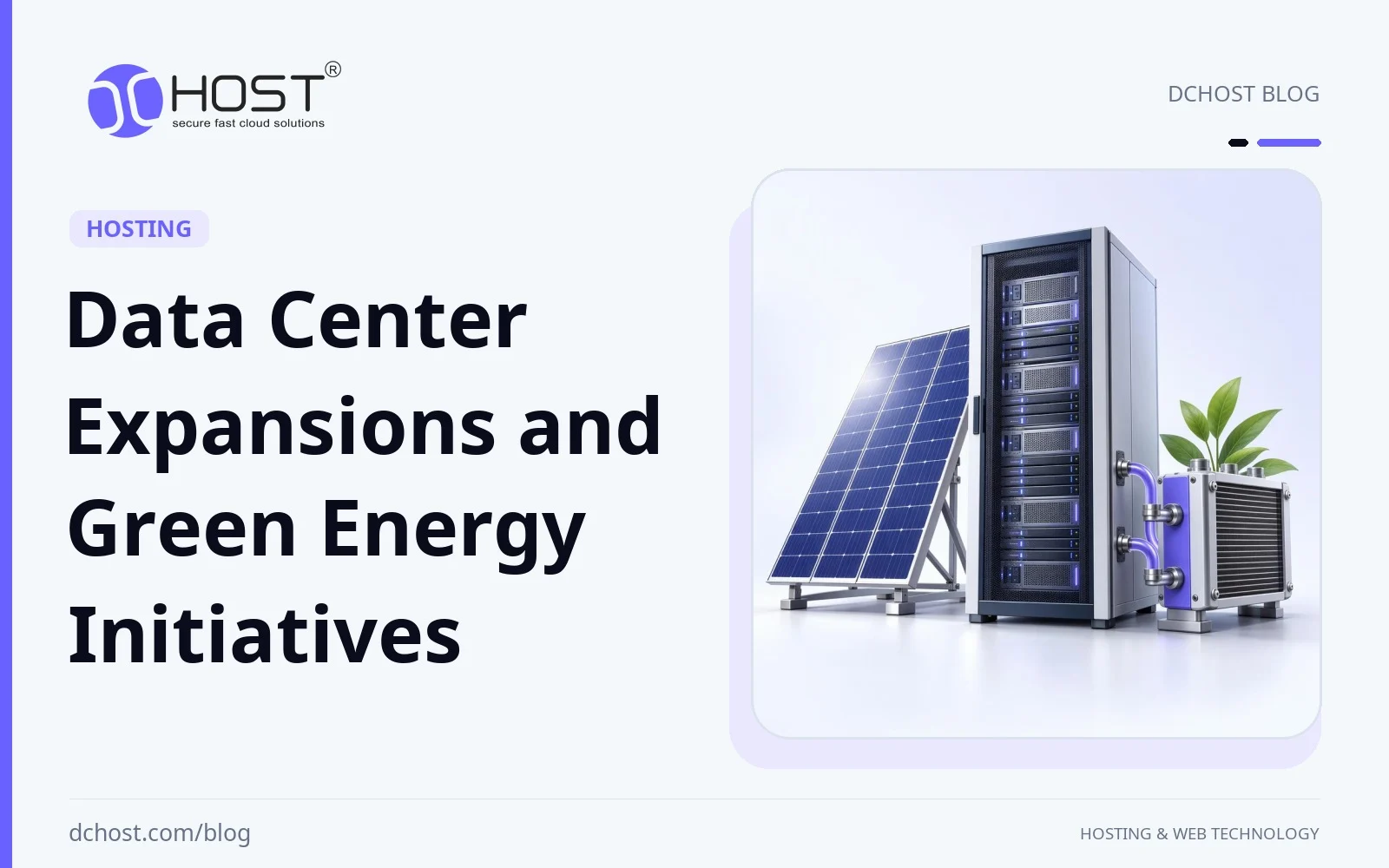
- On‑site generation: solar panels on roofs or adjacent land, sometimes small wind turbines.
- Power Purchase Agreements (PPAs): long‑term contracts to purchase renewable electricity or settle its value financially, which can help finance projects supplying energy to the grid.
- Green tariffs and certificates: utility offerings or separately purchased energy attribute certificates that support renewable electricity claims for a specified amount of consumption.
Annual renewable energy matching does not mean a server runs on renewable electricity every minute: grid supply varies by location and time. Renewable procurement can reduce reported market‑based emissions when the relevant accounting criteria are met, but certificates are not carbon offsets. Physical emissions reductions depend on factors such as when and where generation occurs and whether procurement enables additional renewable supply.
Energy mix is a useful criterion when comparing facilities and locations. If two regions offer similar latency and network quality, compare their grid emissions and renewable procurement options alongside reliability, cost and compliance requirements.
2. Cooling Efficiency and Free Cooling
Cooling is an important component of non-IT energy consumption in a data center; its share depends on climate, load and facility design. Expansions offer an opportunity to improve efficiency by adopting approaches such as:
- Hot aisle / cold aisle containment: physically separating hot exhaust air from cold intake air so the cooling system works less.
- Free cooling: using favorable outdoor conditions through air‑side or water‑side economizers to reduce mechanical refrigeration; some designs use evaporative assistance.
- Liquid and direct‑to‑chip cooling: in high‑density AI racks, liquid cooling can handle concentrated heat loads; total energy savings depend on the full cooling design and operating conditions.
Airflow planning matters in new server rooms and retrofits: appropriate perforated-tile placement in raised-floor designs, blanking panels, cable management and containment can reduce cooling overhead. Our more detailed thoughts on these topics are covered in our article on data center sustainability initiatives that actually make a difference.
3. Hardware Efficiency and Lifecycle Management
Not all watts are equal. A modern server CPU or GPU can deliver far more work per watt than hardware from five or six years ago. During expansions, operators can evaluate:
- High‑efficiency power supplies (80 PLUS Platinum/Titanium).
- Newer CPU generations evaluated for better performance per watt on the intended workloads.
- NVMe storage where it can reduce I/O bottlenecks and enable workload consolidation.
Equally important is what happens at the end of life. Responsible providers plan for secure decommissioning, component recycling and reuse where possible. Lifecycle planning should weigh reuse in suitable roles against replacement, considering operating energy, the embodied impact of new hardware and secure recycling.
4. Grid Interaction, Batteries and Backup
Backup generators and UPS systems remain important for resilience. Grid‑interactive designs also consider how a facility can cooperate with the grid while preserving the reserve capacity needed for outages:
- Battery energy storage systems (BESS) that can support brief grid events without firing up diesel.
- Demand response programs where non‑critical loads can be reduced when the grid is strained.
- More efficient generators and cleaner fuels for truly unavoidable backup needs.
These are invisible to you as a hosting, VPS or dedicated server customer, but they strongly influence both environmental impact and long‑term cost stability. A site’s energy strategy can reduce exposure to grid pricing and fuel costs, depending on its supply contracts, demand flexibility and backup requirements.
5. Measurement, Reporting and Continuous Improvement
Measurement is essential to evaluating green initiatives. A monitoring program can track power usage at rack, row and hall level, monitor PUE, and review trends when new equipment or cooling changes are introduced. For related background, see our piece on data center sustainability initiatives on the rise: start with realistic baselines, then iterate.
Also track site-level WUE (Water Usage Effectiveness): total annual site water use divided by total IT equipment energy use for the same reporting year, expressed in litres/kWh. Include all on-site water uses, including humidification where used, not just cooling water. This is particularly important in water-stressed locations. Replacing an evaporative cooling tower with a dry cooler can reduce site water use and WUE, but may increase energy consumption depending on climate and operating temperatures. Evaluate water and energy use together rather than optimizing PUE alone.
For you as a customer, transparency is key. Providers should be willing to talk about their PUE targets, energy mix and sustainability roadmap – even if the numbers are not perfect yet. The direction of travel matters as much as the current snapshot.
Planning Capacity Expansions with Sustainability in Mind
Expansion planning should address two questions from day one: “How will the added capacity support customers’ growth?” and “How can the design avoid locking in a wasteful energy footprint for the next decade?” Considering both together helps align capacity, network and sustainability decisions.
Location, Latency and Power Mix
Start by mapping demand: where are users, what latency targets make sense for their workloads, and what regulatory requirements apply to their data? Then compare candidate sites using energy data: grid carbon intensity, renewable penetration, local climate (for free cooling) and available power capacity.
A lower-carbon location is not necessarily the most resilient or the least exposed to price changes. Evaluate renewable investment alongside grid capacity, connection timelines, power contracts and incentives for efficient facilities. Renewable growth alone does not rule out grid constraints or pricing spikes.
Network and IP Planning for New Sites
Expansions are also an opportunity to review network capacity and IP addressing needs. Planning options include:
- New uplinks and diverse carriers for redundancy.
- Additional IPv4 and IPv6 allocations where justified.
- Backbone links between data centers for replication and disaster recovery.
If you are following industry developments, you may have read our article on RIPE NCC data center expansions and what they mean for your IPs and hosting. Network planning can contribute to sustainability, but more IPv6 adoption does not by itself guarantee fewer hops or lower power use. Evaluate routing and service consolidation against measured traffic, equipment utilization and energy consumption rather than assuming network changes will save power.
Modular Growth Instead of Overbuilding
Building far more capacity than is realistically needed can leave a half‑empty hall operating inefficiently for years. Modular designs offer an alternative:
- Racks and power distribution added in well‑planned phases.
- Cooling scaled with containment and incremental CRAC/CRAH additions.
- Server clusters right‑sized to the next 12–24 months of demand, not to a vague long‑term guess.
Modularity can help align power and cooling capacity with demand, supporting PUE and cost management. As more efficient hardware generations become available, later modules can incorporate them rather than committing the entire build to one generation of technology.
Balancing AI, High‑Density Racks and Classic Hosting
High‑density AI and GPU racks can easily draw several times the power of a classic web hosting rack. Mixing these without accounting for power and cooling requirements can create hotspots and waste energy. An expansion design could separate workloads into:
- High‑density zones with tailored power and liquid/advanced cooling for AI and analytics.
- Standard density zones optimized for VPS, shared hosting, email and moderate databases.
- Storage‑optimized zones designed around capacity and IOPS rather than pure CPU density.
This zoning can help match power and cooling provision to different workload densities, from shared hosting to dedicated servers and colocation. Its efficiency depends on utilization and the actual cooling design. For a wider view of how demand patterns reshape infrastructure, you can also read our article on how data center expansions are keeping up with cloud demand.
What This Means for Your Hosting, VPS, Dedicated and Colocation
All of this infrastructure work might sound far removed from choosing a hosting plan, a VPS, a dedicated server or a colocation rack. In reality, it affects you directly in several ways.
1. Performance and Latency
Expansions into new regions can give you more location choices. Placing workloads closer to users can reduce network latency and help response times and latency-sensitive Core Web Vitals, though application performance also matters. For a geographically split audience, additional sites may make multi‑region architectures more feasible, but cost-effectiveness depends on replication, traffic and operational requirements. For example, an e‑commerce site, booking service or SaaS dashboard could benefit from a location nearer its core market; SEO and conversion gains should be measured, not assumed.
2. Reliability and Uptime
Expansion designs can incorporate redundant power equipment, independent power distribution paths, dual uplinks, carrier diversity and separation between halls. Equipment capacity redundancy, such as N+1, should not be confused with independent distribution paths. Assess the actual design to identify which single points of failure remain for your hosting stack. If you are responsible for uptime, we recommend pairing this with active monitoring – our website uptime monitoring and alerting guide for small businesses is a good practical starting point.
3. Cost Stability Over Time
Green initiatives are sometimes perceived as “expensive extras.” Efficient power and cooling can reduce operating costs over the medium term. A lower PUE reduces facility overhead relative to IT energy use, but neither a low PUE nor renewable sourcing alone guarantees stable electricity prices. Exposure to price swings depends on supply contracts and tariff terms, while customer pricing also depends on the provider’s commercial terms.
4. ESG, Compliance and Brand Reputation
Many businesses now include infrastructure emissions in their ESG reporting. Even if you are not yet formally reporting, customers increasingly care about where and how their data is hosted. Being able to say “our websites and applications run in energy‑efficient data centers with a meaningful renewable strategy” is becoming a competitive advantage. Choosing a provider that is transparent about sustainability plans simplifies your own reporting and communications.
5. Future‑Proofing Your Architecture
Expansions into additional regions can support multi‑region failover, active‑active clusters, geographically distributed backups and regional hosting for specific data categories. Feasibility still depends on network connectivity, application design, cost and applicable compliance requirements. Capacity growth and green energy initiatives should be evaluated alongside projected energy use and spending; they do not by themselves guarantee environmentally or financially sustainable scaling.
Practical Checklist: Evaluating a Green Data Center for Your Workloads
You do not need to be a facilities engineer to ask the right questions. When you evaluate hosting providers and data centers – whether for simple shared hosting or a full colocation cage – use this practical checklist.
1. Energy Mix and Transparency
- Do they publish or share information about their energy sources (renewables vs fossil)?
- Are there PPAs or green tariffs in place, or on‑site generation?
- Is there a roadmap for improving the energy mix over the next 3–5 years?
2. PUE and Efficiency Targets
- What is the current average PUE and how is it measured (annual, seasonal, by hall)?
- What efficiency gains have they achieved in the last expansion or retrofit?
- Are containment, free cooling or liquid cooling used where appropriate?
For deeper background on why these details matter, you can refer to our article on the quiet revolution in data center sustainability initiatives, where we walk through how small design decisions add up to major efficiency gains.
3. Backup Power and Grid Interaction
- Are there modern battery systems that can handle brief outages without diesel?
- How often are generators tested and what fuels are used?
- Is the facility part of any demand‑response or grid‑stability programs?
4. Hardware and Lifecycle Policies
- How often are server generations refreshed?
- Is there a clear, secure and environmentally responsible decommissioning process?
- Are high‑efficiency power supplies and components used by default?
5. Location, Compliance and Network Design
- Does the region fit your compliance needs (KVKK, GDPR, sector rules)?
- What is the carrier mix and peering situation for latency‑critical workloads?
- Is there an easy path to multi‑region or cross‑data‑center setups if you grow?
For a foundational view of how location, networking and physical infrastructure come together, our primer on what a data center is and why it matters for web hosting can help put these questions into context.
Planning Your Next Move with dchost.com
Data center expansions and green energy initiatives can shape the economics and capabilities of hosting. New racks, power paths and cooling upgrades should be evaluated for both capacity needs and long-term resource use. Sustainability belongs in product evaluation as well as facilities planning. Whether assessing a new hosting region, a VPS cluster, dedicated servers or colocation capacity, ask how the design affects performance, uptime, cost and environmental impact.
If you are planning your next phase – consolidating shared hosting onto VPS, moving a growing store to a dedicated server, or colocating your own hardware – define your performance requirements alongside your sustainability goals. Compare location and latency options, applicable regional compliance requirements, and backup and disaster recovery arrangements. For any plan you consider from dchost.com, request documentation of the underlying facility’s energy sourcing and efficiency, and assess it against those requirements.