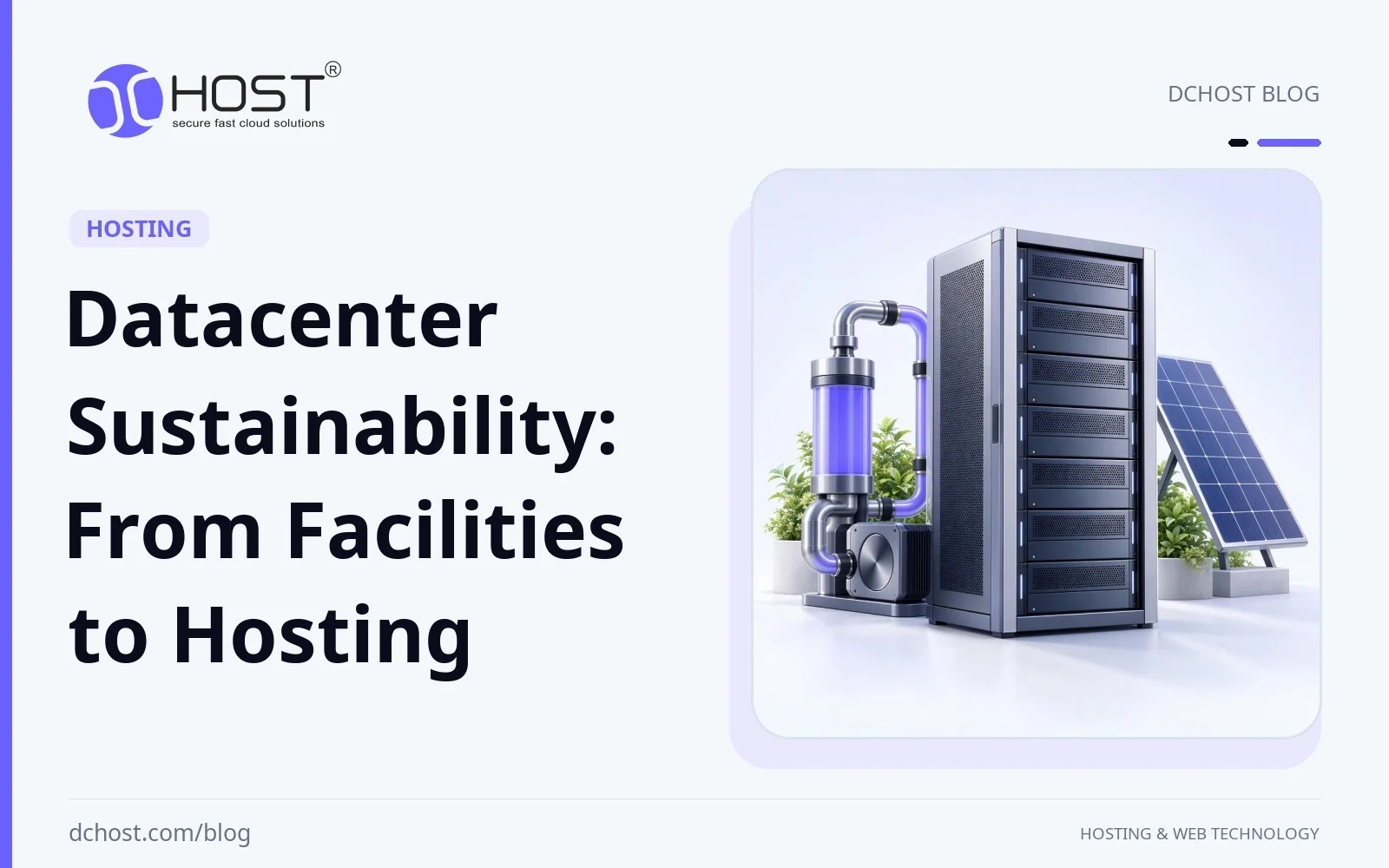
Sustainability is an infrastructure planning consideration alongside uptime, latency and cost. A useful assessment connects a workload’s energy, water and hardware requirements with the facility and electricity sources that support it. Costs, customer requirements and applicable reporting obligations depend on the project and location; evaluate them using defined measurement boundaries rather than broad “green” claims. This article covers power, cooling, hardware lifecycle and hosting choices, including VPS, dedicated servers and colocation as general architecture options. You can apply the workload and provider checks even when managing a single server.
Why datacenter sustainability is a planning priority
Internet services depend on physical servers, storage, networking, cooling and electricity, even when customers never see that infrastructure. Assessing how these systems support useful work helps connect procurement and operational decisions. The guide to what a data center is and why it matters for hosting introduces the underlying components.
Questions to Include in Datacenter Design
When evaluating new locations or upgrading existing halls, providers need to consider several drivers:
- Energy and cost: Measure the electricity required for IT, cooling and power distribution; apply the relevant tariff and expected load profile.
- Applicable requirements: Identify the reporting, efficiency, water-use and other obligations that actually apply to the facility and jurisdiction. Record their scope and effective dates.
- Customer criteria: Check the requirements in the specific contract or request for proposal, including the evidence and reporting period requested.
- Site constraints: Confirm electrical connection capacity, delivery schedule, water availability, permits and local operating conditions with the responsible parties.
These factors can create tradeoffs among cost, energy, water and reliability. Evaluate the options under the same workload and service requirements. A smaller virtual allocation may reduce a bill without reducing physical energy use by the same amount, so distinguish resource sizing from measured environmental outcomes.
Understanding the datacenter sustainability stack
For a structured assessment, divide the infrastructure into three layers:
- Facility level: The building, electrical infrastructure and cooling systems that keep everything powered and within temperature limits.
- IT infrastructure level: Servers, storage, networking hardware and the virtualization stack that actually runs workloads.
- Operational level: Monitoring, automation, capacity planning and lifecycle management processes.
Consider all three layers together: a reduction at one layer can be offset by added processing, storage or cooling elsewhere.
Key metrics: PUE, WUE and carbon intensity
These metrics help describe different parts of the assessment; define the period, boundary and method for each:
- PUE (Power Usage Effectiveness): The ratio of total facility energy to IT equipment energy over the same measurement period. A PUE of 1.5 means that for every 1 kWh used by IT equipment, 0.5 kWh goes to cooling, lighting, UPS losses and other overhead. Lower PUE indicates less facility overhead relative to IT energy, not necessarily lower total energy use or emissions.
- WUE (Water Usage Effectiveness): For site WUE, annual on-site water use, including cooling and humidification, divided by annual IT equipment energy, typically expressed in litres/kWh. It is especially relevant in water-stressed regions; state the measurement boundary when comparing facilities.
- Carbon intensity of energy: How much CO₂ is emitted per kWh drawn from the grid, often expressed in gCO₂/kWh. You can have a very efficient facility running on carbon‑heavy power, or a slightly less efficient one powered mostly by renewables.
Providers can request these metrics from datacenter partners to inform capacity placement and the design of high‑density zones for compute- or I/O-intensive workloads, such as VPS clusters and database servers using NVMe storage.
Energy efficiency: doing more with every kilowatt
Cooling and Total Energy Use
Cooling removes heat from IT equipment while maintaining its operating conditions. It can contribute substantially to facility overhead, alongside power-delivery losses. Compare cooling changes using both cooling-system energy and any resulting change in server power, rather than assuming a lower cooling reading proves a lower total.
- Hot and cold aisle containment: Arranging racks so that cold air is delivered to intakes and hot exhaust air is captured and returned separately. Proper containment can reduce cooling energy and PUE; the savings and installation disruption depend on the existing layout.
- Free cooling and economizers: Using suitable outdoor conditions through direct air exchange or heat exchange can reduce mechanical cooling demand. Check temperature, humidity and air quality requirements, and evaluate energy and water use together, particularly for evaporative systems.
- Liquid and direct-to-chip cooling: For high-density racks (AI, GPU clusters, heavy databases), liquid cooling may support greater rack density and lower cooling energy per kW of IT load. Include pumping, heat rejection, water use, maintenance and hardware compatibility in the comparison; higher density alone does not establish lower total consumption.
- Smarter setpoints: Raising supply-air temperatures within equipment specifications and applicable ASHRAE guidance can reduce mechanical cooling demand. Monitor rack inlet temperatures and total cooling plus IT power: server fans may speed up as inlet temperatures rise, offsetting some savings.
When planning high‑density zones for VPS and dedicated server platforms, assess potential gains from containment and optimized airflow before deciding whether more chillers or additional hall space are needed.
Efficient power distribution and UPS design
Power can pass through switchgear, UPS systems, distribution units and server power supplies, with utility and backup-generation arrangements depending on the design. Conversion and distribution losses form part of facility overhead. Design options to evaluate include:
- Use high‑efficiency UPS systems: Transformerless designs and “eco modes” can reduce conversion losses, but assess efficiency at the expected load and the protection and transfer characteristics of each operating mode rather than assuming reliability is unchanged.
- Distribute at higher voltages: Higher-voltage distribution, such as 400V three-phase or 230V single-phase where supported by regional standards and equipment, can reduce current and conductor requirements for a given load. Any reduction in conversion stages depends on the electrical design.
- Standardize on efficient PDUs: Metered and switched PDUs help identify underutilized circuits and stranded capacity.
- Pair with high‑efficiency PSUs: Server power supplies certified 80 PLUS Platinum or Titanium can reduce conversion losses compared with lower-efficiency units; compare efficiency at the expected operating load.
From a customer perspective, you rarely see these layers directly. Choosing a hosting provider with an efficient power chain can reduce the facility energy overhead associated with your workload, even if your VPS configuration stays the same. The emissions benefit also depends on the energy source.
Server, storage and virtualization efficiencies
On the IT side, sustainability is mainly about using hardware as efficiently as possible—pushing more useful work through each watt of power and each unit of space.
- Right-sized CPUs and RAM: A server averaging 5% CPU utilization may warrant investigation, but average CPU alone does not establish spare capacity. Check peak demand, memory, I/O, resilience and useful work before consolidating.
- Storage choices: Compare candidate drives and systems using throughput or IOPS per watt at the intended workload, including idle consumption and capacity requirements. The NVMe VPS hosting guide explains NVMe, SATA SSDs, IOPS and I/O wait; the interface label alone does not establish energy savings.
- Virtualization and containers: Consolidation can reduce consumption if released physical equipment is shut down or enters a lower-power state. Preserve isolation and acceptable failure impact.
- Storage tiering: Match access frequency to an appropriate storage tier and test retrieval. Savings depend on hardware, access patterns and power management; preserve independent backups and required recovery times.
For you as an infrastructure owner, this translates into smarter sizing decisions. Choosing a well‑configured VPS or a compact dedicated server that fits your workload can reduce wasted capacity compared with running a much larger machine “just in case.” Actual sustainability gains depend on physical resource use, hardware efficiency and the electricity supply.
Renewable energy and carbon‑aware operations
Beyond efficiency: cleaning up the power supply
Efficiency alone cannot bring emissions to zero. Once you have optimized cooling, power distribution and server utilization, the next layer is the origin of the electricity itself.
Electricity-sourcing and workload-scheduling options to evaluate include:
- On-site generation: Assess usable space, output timing, connection requirements and backup capacity for generation such as rooftop solar.
- Power purchase agreements: Evaluate the contract, generation attributes and reporting criteria. A long-term purchase does not by itself prove new generation was caused by the contract or that supply matches consumption each hour.
- Energy attribute certificates: Check applicable quality criteria, geography, vintage and disclosure. These instruments document energy attributes; they do not establish continuous physical delivery of renewable electricity.
- Load shifting: Move only flexible work within its deadlines and dependencies, using relevant grid carbon-intensity data. Backup scheduling must continue to satisfy recovery objectives.
When evaluating a datacenter location, consider its electricity mix and the long‑term availability of low‑carbon power alongside latency and network connectivity.
Carbon‑aware scheduling and architecture
As a customer, you can also make your architecture more carbon‑aware, even if you never sign a PPA yourself. Some practical options:
- Schedule non-urgent jobs for lower-carbon hours: Nightly reporting, search index rebuilds or media transcoding may be shiftable within their deadlines and dependencies. Use local grid carbon-intensity data; off-peak hours are not necessarily greener. Shift backups only within the required recovery-point and recovery-time objectives; preserve independent copies and isolated restore tests.
- Use caching and CDNs selectively: Cache reusable public responses, not personal or authorization-dependent responses in shared caches. Fewer repeated origin queries can reduce origin processing, but assess cache-node power, storage and transfer as well before claiming total energy savings.
- Choose regions carefully: Compare latency from actual user networks and electricity sourcing alongside water stress, redundancy and applicable data-location requirements. Geographic proximity alone does not establish a shorter network route.
- Architect for elasticity: Consider scaling down test and staging environments outside working hours after checking dependencies, persistent data and restart time. Billing savings depend on the plan, and storage or IP charges may continue. Energy savings depend on what happens to the underlying physical hardware.
These changes may be possible without rewriting your entire stack. Caching and scaling down can reduce energy use, while scheduling and region selection can reduce emissions without reducing energy per request. Track both total energy and emissions alongside per-request metrics.
Sustainable hardware lifecycle: from procurement to recycling
Choosing the right hardware in the first place
Sustainability starts long before a server is racked. Manufacturing CPUs, memory, storage and chassis has an embodied carbon cost. That makes the first decision—what to buy and how much of it—critical.
- Prefer efficient SKUs: CPU models marketed for performance per watt may suit high‑density VPS and shared hosting nodes, but compare whole-system efficiency for the intended workload.
- Balance density and serviceability: Extremely dense designs might look efficient on paper but be hard to cool or maintain, leading to more downtime and replacements.
- Standardize where possible: Using a small number of well‑tested platform designs simplifies spares management and reduces waste from incompatible parts.
Using hardware fully without burning it out
Higher utilization does not by itself determine hardware lifespan. Thermal stress, airflow, power quality and workload-related wear all matter. To make fuller use of hardware while managing these risks:
- Design racks and containment so that even high‑utilization nodes stay within safe temperature envelopes.
- Use proactive monitoring for disk health, power supplies and temperature trends to plan replacements before failures.
- Reassign older but still reliable servers to less demanding roles—such as backup targets, development platforms or lower‑intensity dedicated offerings—before eventually retiring them.
This staged lifecycle can spread each server’s embodied carbon over more useful compute hours and avoid premature disposal. Retention decisions should also weigh energy efficiency, reliability and continued security support.
Responsible end‑of‑life handling
Eventually, every server reaches the end of its productive life. How you handle that phase is a core part of any datacenter sustainability initiative:
- Documented data sanitization: Use media-appropriate secure erasure or physical destruction of drives, with verification and records, to protect customer data.
- Component harvesting: Salvaging power supplies, memory or network cards for reuse where supported.
- Recycling through audited partners: Ensuring metals, plastics and hazardous materials are processed according to environmental standards.
A disciplined lifecycle strategy can reduce waste and demand for new manufacturing by extending useful service, reusing suitable components and responsibly recycling retired equipment.
Network design, IPv6 and address efficiency as sustainability tools
Network design affects capacity requirements and operational complexity. Routing, translation, peering and caching can also change equipment and transfer needs. The power impact depends on the hardware, implementation and traffic, so include added network components in the measurement boundary.
Why IPv6 and smarter addressing matter
One pressure point is the ongoing scarcity of IPv4 addresses. Scarcity can encourage providers to share addresses through NAT. Translation adds processing and state-management requirements, but NAT, firewalls and overlays do not each necessarily require separate, always‑on hardware.
IPv6 can reduce address-sharing NAT where end-to-end IPv6 connectivity is available; it does not remove the need for firewalls or other security controls. Its larger address space allows operators to:
- Assign public addresses more cleanly to servers and VPS instances.
- Reduce dependence on large‑scale NAT, potentially retiring dedicated translation appliances once IPv4 requirements permit.
- Plan aggregatable address allocations, while recognizing that routing policy and topology determine the resulting routing-table size.
The guide to IPv6 adoption and infrastructure planning discusses transition choices. Removing unneeded translation equipment can reduce power and cooling demand. IPv6 adoption alone does not establish savings, especially while IPv4 and IPv6 operate together.
Peering, caching and traffic locality
Review actual traffic routes and cache behavior when comparing these options:
- Regional peering and IXPs: Exchanging traffic locally rather than across continents can reduce latency and upstream transit demand. Verify actual routes and performance; local peering alone does not guarantee either result.
- CDNs and edge caches: Serving reusable static content close to users can reduce repeated hits on origin servers and long-haul links.
- Anycast DNS and smart routing: Directing requests to an appropriate healthy service instance can reduce round-trip time and long-haul traffic. Anycast follows network routing decisions, not necessarily geographic proximity; DNS locality alone does not ensure application-traffic locality.
When planning network expansions, weigh performance and redundancy alongside how each new peer or cache node could reduce unnecessary long‑haul traffic. Assess any energy savings against the added node’s power use rather than assuming a sustainability benefit.
Evaluating Hosting Choices for Sustainability
Most of the initiatives above happen behind the scenes in the facility. As a customer, your main levers are the architectures you deploy and the hosting models you choose. The decisions you make about shared hosting, VPS, dedicated servers and colocation directly impact how efficiently datacenter resources are used.
Right‑sizing: a practical sustainability starting point
Over‑provisioning can leave paid-for resources idle. For example, a server bought “for the next three years” without revisiting capacity could remain lightly utilized. Review that headroom against peak demand, growth and resilience needs before reducing it.
We have a detailed guide on cutting hosting costs by right‑sizing VPS, bandwidth and storage, and reducing unnecessary resource use can support sustainability as well as cost savings:
- Use measured average and peak demand as a baseline; retain growth and failure headroom.
- Compare VPS and dedicated capacity with actual workload variability, plan limits and resize requirements. Smaller virtual allocations do not prove reduced physical power.
- Separate databases, caches and applications only when independent sizing or operational needs justify the added instances, network traffic and idle capacity.
- Before removing volumes, snapshots or staging environments, check dependencies, retention and recovery requirements; keep independent backups and verify isolated restoration.
Evaluate useful work per unit of energy alongside total consumption. Higher utilization can improve that ratio when it replaces otherwise idle capacity, but overloaded systems, extra retries or additional equipment can offset the benefit.
When colocation makes sustainability sense
Colocation—housing your own hardware in a professional facility—can also be a sustainability tool when used thoughtfully. If you already operate on‑premises racks in an office or small server room, moving that equipment into a purpose‑built datacenter can:
- Reduce overall power usage thanks to more efficient cooling and power distribution.
- Improve uptime through redundant power feeds, generators and network paths.
- Allow you to consolidate scattered servers into a smaller, better‑utilized footprint.
Our article on the benefits of hosting your own server with colocation services dives into these trade‑offs in detail. From a sustainability perspective, compare the facilities’ cooling and power overheads, electricity sources and expected hardware utilization: a professional datacenter can improve efficiency, but the move alone does not guarantee a lower environmental footprint.
Shared hosting and VPS plans can improve resource efficiency by letting multiple customers share hardware, but their sustainability profile depends on actual utilization, facility efficiency and electricity sourcing. Dedicated servers and bare‑metal clusters may be necessary for workloads with specific compliance, performance or custom networking requirements, but avoiding unnecessary idle capacity remains important.
A practical rule of thumb is:
- Consider shared hosting for lightweight sites whose capacity, security and application requirements fit the plan.
- Consider a VPS when the selected plan provides the access, stack and resources you need; verify administration responsibilities and resource guarantees.
- Consider dedicated servers when whole-machine capacity or control is justified. Colocation additionally requires customer hardware and arrangements for physical operation, maintenance and replacement.
Right‑sizing can reduce both resource waste and cost, but retain the capacity and redundancy needed to meet performance and reliability requirements.
Practical checklist: starting your own sustainability journey
You do not need to control an entire datacenter to take sustainability seriously. Whether you manage one VPS or a portfolio of business‑critical applications, you can start with a simple, practical checklist.
- Measure what you can today: Enable detailed resource monitoring on your servers. Look at average and peak CPU, RAM, disk IO and bandwidth usage. These are not direct energy measurements: distinguish power in kW from energy in kWh. Request physical measurements with defined boundaries and periods where available, and disclose uncertainty when using estimates.
- Find obvious waste: Identify idle instances, oversized dedicated servers, forgotten test environments and potentially obsolete backups. Before removing volumes, snapshots, backups, logs or other data, check dependencies, security and retention obligations, and recovery requirements. Preserve independent backup copies and isolated restore tests.
- Right-size and consolidate: Move light workloads onto shared hosting or smaller VPS plans where appropriate. Preserve peak capacity, growth and failure headroom, security boundaries and acceptable failure impact. Consolidation can save energy when released physical equipment is shut down or enters a lower-power state; smaller virtual allocations alone do not prove savings.
- Optimize application efficiency: Implement caching for eligible public responses, workload-appropriate database indexing and HTTP optimization. Measure results rather than assuming each change reduces resources or energy.
- Review regions and routing: Check actual user latency and electricity sourcing alongside water stress, redundancy and applicable data-location requirements.
- Talk to your provider: Ask about PUE, WUE, renewable energy sourcing and hardware lifecycle policies, including the scope and reporting period of any metrics provided. Track total energy and emissions as well as energy per unit of useful work where possible.
- Document a simple policy: Even a one-page internal note on how you choose instance sizes, regions and hosting models can prevent regressions later.
Assign an owner and review schedule for these measurements and decisions. Revisit the plan when workload, hardware, tariffs, recovery requirements or applicable obligations change.
Building a greener infrastructure, one decision at a time
Datacenter sustainability initiatives can sound abstract when described only in terms of megawatts, PUE targets or multi‑year carbon strategies. But at their core, they boil down to a series of concrete design choices: how efficiently you cool hardware, how fully you use each server, where your power comes from, how you route traffic and what happens to equipment when it reaches the end of its life. Every customer architecture that runs on our platforms at dchost.com is part of that picture.
You do not need to overhaul everything overnight. Start by measuring, address verified waste without compromising security or recovery, and make sustainability a standard question whenever you choose a hosting model, datacenter region or new project architecture. When discussing shared hosting, VPS, dedicated servers or possible colocation with dchost.com, confirm the selected service’s features and the availability and scope of architectural support. Lower bills, lower physical energy consumption and lower emissions are distinct outcomes; report only gains you can measure or substantiate.