Sustainable Data Centers
Data centers quietly power everything your business does online: websites, email, SaaS tools, analytics, backups and much more. The problem is that traditional facilities also consume enormous amounts of electricity, cooling and hardware resources. As energy prices and environmental expectations rise, the question is no longer just “Is my hosting fast and reliable?” but also “How sustainable is the infrastructure under it?” Sustainability belongs in architecture reviews, capacity planning and hosting procurement decisions. In this article, we will walk through what actually makes a data center sustainable, which metrics matter (and which are mostly marketing), and how those choices translate into real benefits for your sites and applications. We will also explain what to look for in a data center’s sustainability practices, and what you can do when selecting shared hosting, VPS, dedicated servers or colocation to reduce both your environmental footprint and long‑term costs.
What Makes a Data Center Sustainable?
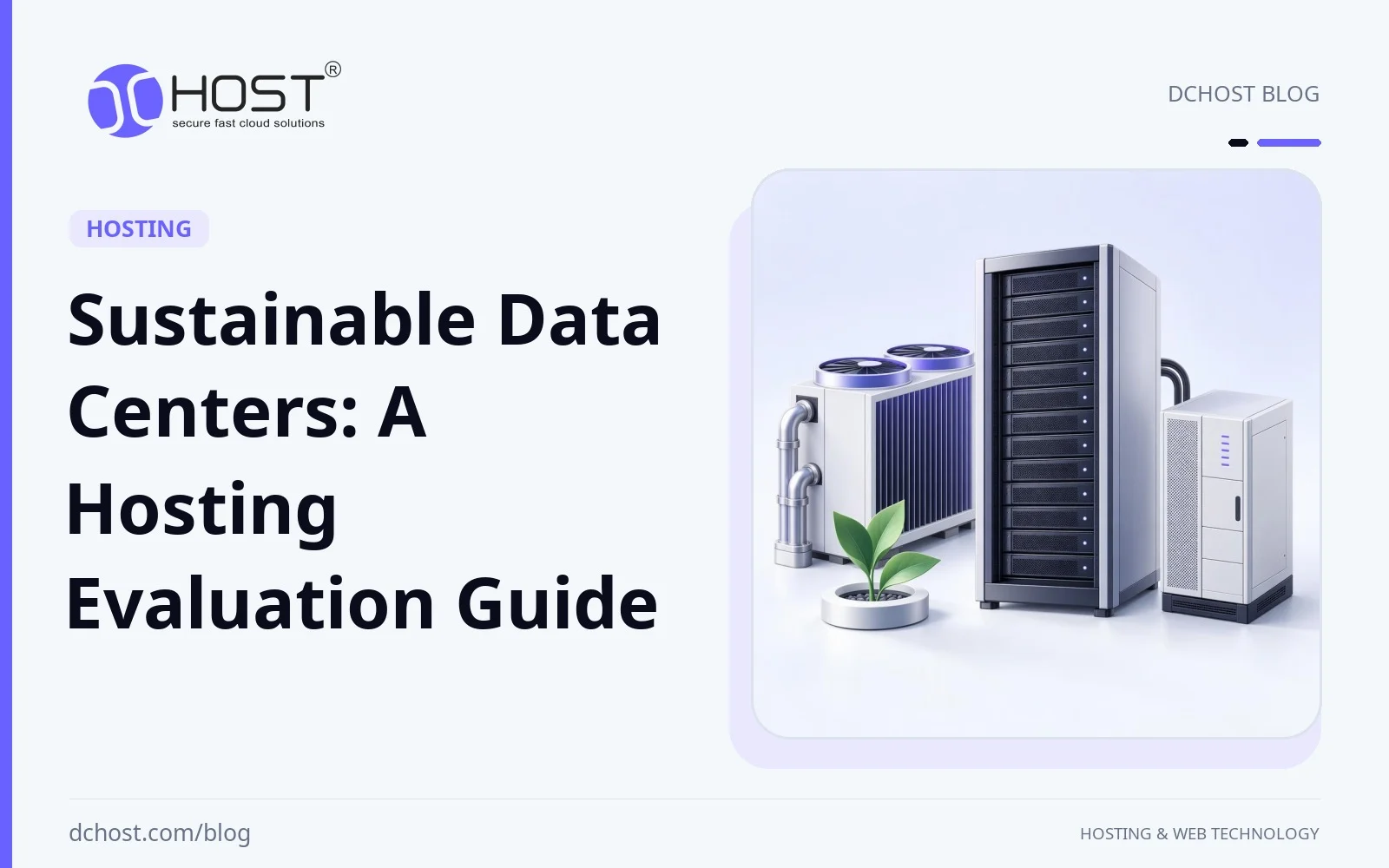
Before diving into metrics and technologies, it helps to be clear on what “sustainable data center” really means. It is not just putting solar panels on the roof or planting a few trees. A truly sustainable facility is designed and operated to minimize its environmental impact across energy, water, hardware and land use, while still delivering high performance and reliability.
At a high level, sustainable data centers focus on:
- Energy efficiency: Using less electricity per unit of IT work (per request, per VM, per TB stored).
- Low carbon intensity: Powering that electricity from renewable or low‑carbon sources as much as possible.
- Responsible cooling and water use: Delivering stable temperatures with minimal water consumption and smart use of local climate conditions.
- Hardware lifecycle and circularity: Extending server life when safe, refurbishing where possible and recycling components at end of life.
- Smart capacity and network design: Avoiding wasteful over‑provisioning and reducing unnecessary traffic between regions.
If you want a refresher on how racks, power and cooling tie together under the hood, our article on what a data center is and why it matters for web hosting is a good starting point. Building on that foundation, this piece will stay focused on what changes when sustainability becomes a first‑class design constraint instead of an afterthought.
Energy Efficiency: A Key Lever
Energy is a major operating cost and source of environmental impact for data centers, though its relative importance depends on the electricity mix, facility design and hardware lifecycle. That is why energy efficiency is usually the first lever operators pull when they decide to “go green.”
Understanding PUE (Power Usage Effectiveness)
The most common metric you will encounter is PUE – Power Usage Effectiveness. It is defined as:
PUE = (Total facility energy) / (IT equipment energy), measured over the same reporting period and facility boundary.
If a data center’s total power draw is 1.6 MW and its IT equipment (servers, switches, storage) uses 1.0 MW, the instantaneous ratio is 1.6. Reporting-period PUE uses accumulated energy rather than a single power reading. The closer PUE is to 1.0, the more efficient the facility is, because less power is going into overhead like cooling, UPS losses and lighting.
Illustrative PUE ranges, not benchmarks for a particular facility type:
- Higher overhead: PUE 1.8–2.5+
- Lower overhead: PUE 1.2–1.5
- Very low overhead: PUE close to 1.1–1.2
PUE measures facility overhead relative to IT energy use. It says nothing about where the energy comes from or how much useful work the IT equipment performs. Compare reported values with attention to climate, utilization, measurement boundaries and reporting periods. A lower PUE can reduce electricity costs for the same IT energy demand, but does not guarantee stable hosting prices. For related discussion, see our article on data center sustainability, energy cost and performance.
Cooling: From “Just Keep It Cold” to Smart Thermal Design
The energy used for cooling is a major contributor to facility overhead. Sustainable data centers treat cooling as an engineering discipline, not just a row of big chillers in the basement. Common patterns include:
- Hot and cold aisle containment: Racks are arranged so cold air is delivered to equipment fronts and hot exhaust is captured and removed, instead of mixing. This allows higher supply temperatures and more efficient chillers.
- Free cooling / economization: In suitable climates, outside air or evaporative cooling is used when conditions permit, reducing or eliminating the need for mechanical refrigeration for much of the year.
- Liquid or direct‑to‑chip cooling (especially for AI/CPU‑dense racks): Removing heat with liquid instead of air can drastically improve efficiency for very dense compute loads.
- Smart control systems: Using fine‑grained sensors, variable speed fans and predictive control to keep temperatures stable without overcooling.
For you as a hosting customer, efficient cooling can reduce the energy overhead of hosting. Stable rack temperatures, protection against thermal throttling and resilience during heat waves also depend on cooling capacity, redundancy and operating limits; efficiency alone does not establish reliability. Set temperature targets using measurements at equipment air inlets and the manufacturer’s temperature and humidity limits, rather than treating a general room-temperature range as safe for every device.
Efficient Hardware and Right‑Sizing Capacity
Facility‑side efficiency is only half the story. A data center can have a great PUE and still waste vast amounts of energy if the servers inside are badly utilized. Sustainable operators pay close attention to:
- Server consolidation and virtualization: Running fewer, more powerful modern nodes at higher utilization instead of many under‑used boxes.
- Storage efficiency: Matching media to workloads: NVMe SSDs can serve hot data, while colder data can move to denser storage tiers. Compare energy use for the required performance and capacity rather than assuming a faster interface always uses less energy.
- Network design: Minimizing unnecessary hops and avoiding long, wasteful backhauls between regions.
We explore the performance side of this in our NVMe VPS hosting guide, but there is a sustainability angle as well: the more work each watt of power does, the fewer servers and less electricity are needed to support your workloads.
Renewable Energy and Carbon‑Aware Operations
Even with excellent efficiency, data centers still need electricity. The next question becomes: where does that power come from? This is where renewable energy and carbon‑aware operations enter the picture.
On‑Site Renewables, PPAs and Energy Certificates
Sustainable facilities typically combine several approaches:
- On‑site generation: Solar panels on roofs or nearby land, and wind generation where suitable. Fuel cells are another generation option, but their carbon impact depends on the fuel and how it is produced.
- Power Purchase Agreements (PPAs): Long‑term agreements with renewable energy projects (wind farms, solar parks) at agreed prices. Depending on the arrangement, they can involve electricity delivery or financial settlement; they do not necessarily mean a facility receives power directly from that project.
- Energy Attribute Certificates (EACs, including Guarantees of Origin): Certificates representing the attributes of electricity generation, typically per MWh. Retiring eligible renewable certificates against consumption supports a matching claim under the applicable accounting rules; it does not prove renewable electricity physically supplied the facility at every hour.
A suitable mix of on‑site generation and renewable contracts depends on available land, local resources and procurement options. Certificates may accompany those contracts or be purchased separately, so they are not simply a fallback for small gaps. When assessing a data center, examine its renewable contracts, certificate retirement, local energy mix and matching period rather than relying on a generic “green data center” label.
24/7 Carbon‑Free Energy Matching vs Annual Averages
Many companies proudly claim “100% renewable” based on buying enough certificates over a year to equal their annual consumption. An annual matching claim does not establish round‑the‑clock renewable supply or, by itself, demonstrate additional emissions reductions: grid carbon intensity varies by hour and location.
24/7 carbon‑free energy matching aims to match electricity consumption hour‑by‑hour with carbon‑free generation in the relevant grid region. Carbon‑aware scheduling is a related but distinct practice: shifting flexible workloads toward times or locations with lower electricity carbon intensity. Neither alone establishes sustainability across water use, hardware and other impacts. Operational options include:
- Scheduling flexible batch jobs, such as analytics or cold data syncs, for lower‑carbon grid hours. Backup timing must still meet recovery objectives and required schedules.
- Using battery storage or flexible loads to reduce peak grid demand. Emissions benefits depend on when batteries charge, storage losses and which generation is displaced; peak shaving alone does not guarantee lower emissions.
While no data center can perfectly control the grid, matching consumption more closely to clean energy availability can address timing differences that annual carbon accounting obscures.
Data Center Expansions and Green Growth
AI workloads, video, gaming and SaaS drive demand for new capacity. The real question is how that growth is managed. In our article on data center expansions and green energy initiatives, we looked at how modern sites are being built directly next to renewable sources or in regions with very clean grids.
For customers comparing hosting, VPS or dedicated server locations, a cleaner electricity supply can reduce operational emissions for an equivalent workload. The difference depends on actual electricity sourcing, facility efficiency and hardware utilization; proximity to renewables alone does not establish a lower footprint.
Water, Cooling and Local Environmental Impact
Electricity is not the only resource sustainable data centers must manage carefully. Cooling systems, especially those using evaporative or adiabatic methods, can consume large volumes of water. In a water‑stressed region, this can be just as critical as carbon emissions.
WUE: Water Usage Effectiveness
A useful metric here is WUE – Water Usage Effectiveness, typically expressed as:
Site WUE (L/kWh) = annual on-site water use (liters) / annual IT equipment energy use (kWh), measured over the same reporting year. Count the included site water uses, including humidification where used; do not limit the numerator to cooling water alone. Source-based WUE additionally accounts for water used off-site to produce the energy consumed by the facility.
A lower WUE indicates less water use per unit of IT energy, but should be assessed alongside energy use and local water stress. Water-management options include:
- Evaluating closed‑loop cooling together with its heat-rejection system; a closed coolant loop can still reject heat through a water-consuming cooling tower.
- Leveraging free air cooling in suitable climates to reduce water use.
- Sourcing non‑potable water where possible to reduce demand for drinking water, even if total water use is unchanged.
When comparing facilities, consider both WUE and the local water context: source availability, seasonal drought and competing demand matter as well as annual rainfall.
Thermal Design and Local Climate
Local climate influences cooling design. Cooler conditions can provide more hours of free cooling, subject to humidity and air-quality limits, while hotter conditions may require more mechanical cooling and careful building envelope engineering to reduce heat gain.
These choices influence where it makes sense for you to host latency‑insensitive workloads like archives, backup repositories or secondary disaster recovery servers. For a multi‑region setup, consider keeping latency‑critical workloads closer to users and placing non‑urgent, high‑storage tiers in regions with more favorable energy and water profiles, subject to data-residency and recovery requirements.
Network Efficiency, IPv6 and the Future Footprint of Connectivity
Network design is often left out of sustainability discussions, but it matters. Every router, switch and optical amplifier consumes power. Unnecessary intercontinental detours can increase latency, though the energy impact depends on network equipment, utilization and whether capacity can be reduced.
Smarter Routing and Regional Presence
Sustainable operators aim to:
- Peer directly with major networks and carriers in multiple locations to shorten paths.
- Use modern, energy‑efficient routing hardware with strong power‑per‑bit performance.
- Design topologies that minimize long‑haul backhauls for traffic that should stay local.
This is one reason we are strong advocates of good capacity planning and regional selection on the hosting side. Placing your application in the right region with efficient network paths does more than improve speed; it prevents a lot of unnecessary traffic from bouncing across the globe.
IPv6 Adoption and Sustainable Growth
It might not be obvious at first, but IPv6 adoption also has a sustainability angle. As IPv4 addresses become scarce and expensive, ever‑more complex layers of NAT, tunneling and address translation infrastructure are deployed just to keep things running. Those extra boxes and processes consume power, occupy rack space and increase operational complexity.
Moving toward IPv6‑first connectivity can reduce reliance on IPv4 address translation, but dual‑stack operation retains IPv4 infrastructure and can add operational complexity. In our article on accelerating IPv6 adoption and transforming your network without falling behind, we looked at this mostly from a technical and operational angle, but any sustainability benefit depends on whether translation infrastructure can actually be retired and on the resulting energy use.
For new VPS and dedicated server deployments, verify IPv6 availability and application compatibility for the chosen plan. IPv6 support is a connectivity criterion, not by itself evidence of lower energy use.
Designing Sustainable Hosting Architectures on Top of Green Data Centers
Even the greenest data center cannot fully compensate for a badly designed application architecture. The way you choose and use hosting resources has a direct impact on sustainability. Reducing unnecessary resource use can also make workloads cheaper and more performant, though cost, performance and environmental goals do not always align.
Right‑Sizing: Avoid Paying (and Powering) for Noise
A VPS or dedicated server averaging 5–10% CPU utilization merits a sizing review, but CPU alone does not establish waste: memory, storage, peak demand and availability requirements may justify the capacity. In our guide on cutting hosting costs by right‑sizing VPS, bandwidth and storage, we show how to estimate realistic CPU, RAM and disk needs and grow gradually based on real metrics.
Right-sizing can improve sustainability when it enables consolidation or reduces physical infrastructure power use. A smaller VPS allocation alone does not guarantee that the host draws less power. Practical steps include:
- Starting new projects on modestly sized VPS plans and scaling once steady traffic patterns appear.
- Using horizontal scaling where the workload supports it and nodes can be removed during quiet periods; multiple smaller nodes are not inherently more efficient than one well-sized server.
- Reviewing server metrics quarterly to identify under‑utilized instances that can be resized or consolidated.
Application‑Level Efficiency: Caching, Queries and Static Assets
Unnecessary database queries and oversized images can slow your site and increase processing, memory or bandwidth demands. A few examples of sustainable coding and configuration practices:
- Full‑page and object caching: Reduce repeated work on PHP/Node.js and database layers. Do not put personalized content in shared full-page or CDN caches. Keep WooCommerce cart, checkout and account pages dynamic, adapting cache exclusions to the site’s actual routes and session handling.
- Optimized images and media: Use formats like WebP/AVIF and appropriate compression, as we discuss in our guides to hosting image‑heavy websites and image optimization pipelines.
- Database tuning and indexing: Indexes suited to the query workload can reduce CPU work and IO, while unnecessary indexes add storage and write overhead.
- Efficient cron and background jobs: Run periodic tasks at reasonable intervals, and avoid waking entire stacks for trivial work.
For WordPress, WooCommerce or Laravel workloads, caching and query optimization can reduce repeated processing. Measure the effect on server load; lower load does not translate directly or proportionally into lower energy use per page view.
From a sustainability standpoint, there is no single “correct” hosting type. It depends on your scale and workloads:
- Shared hosting: Multiple sites share the same server resources. This can be efficient for small sites when consolidation improves physical server utilization.
- VPS: Virtual servers consolidate many tenants on powerful physical hosts. When sized correctly, this balances efficiency with isolation and flexibility.
- Dedicated servers: Suitable for sustained heavy workloads or requirements for exclusive physical hardware. Sustainability depends on efficient hardware and appropriate utilization.
- Colocation: You own the hardware but place it in a professional facility. This lets you manage your hardware lifecycle; cooling and power efficiency depend on the selected facility.
If you are weighing VPS against dedicated from a performance and cost angle, our article Dedicated Server vs VPS: Which One Fits Your Business? can help. From a sustainability perspective, the main rule is simple: whichever model you choose, keep utilization healthy, avoid unnecessary over‑provisioning and, if you colocate, select energy‑efficient platforms.
Evaluating Sustainability in Hosting Infrastructure
Sustainability is not a single project or certificate; it is a series of design and operational decisions that compound over time. This thinking can guide how you evaluate data centers, hosting platforms and workload placement.
Facility and Location Choices
When evaluating facilities, look for:
- Transparent PUE and WUE figures with a track record of continuous improvement.
- Strong renewable energy sourcing through PPAs or regionally credible guarantees of origin.
- Modern cooling designs with hot/cold aisle containment and, where suitable, free cooling or advanced chiller systems.
- Clear hardware recycling and e‑waste policies, not just vague marketing language.
Combined with robust physical security and connectivity, these are useful criteria for assessing the resilience and resource efficiency of the environment hosting your shared hosting, VPS, dedicated server or colocated hardware.
Platform Design: Virtualization, NVMe and IPv6‑Ready Networks
On the platform side, design options to evaluate include:
- Efficient virtualization stacks: Consolidating workloads on modern hypervisors so that host servers run at healthy utilization levels instead of idling.
- High‑performance NVMe storage: Shorter IO times can help IO‑bound workloads complete faster, but resource and energy savings should be measured for the workload rather than assumed from the storage interface.
- IPv6‑capable network design: Building dual‑stack services from the ground up, so customers can adopt IPv6 without bolt‑on complexity.
- Monitoring and capacity planning: Tracking resource usage trends to add capacity where it is needed, not just where it is easy.
We have written extensively about these topics from both performance and reliability angles – for example, in our pieces on sustainability initiatives that actually make a difference in real hosting and in our various VPS performance and tuning guides. Performance tuning can also improve resource efficiency, but speed alone does not demonstrate lower energy use.
Colocation and Hardware Lifecycle
For colocation deployments, sustainability considerations include hardware lifecycle and design:
- Choosing efficient power supplies and servers based on performance per watt for the intended workload, rather than density alone.
- Planning reasonable refresh cycles that balance newer, more efficient hardware against the embodied carbon in manufacturing.
- Designing racks with good airflow and cable management to support efficient cooling.
If you are considering colocating your own servers, our guide on the benefits of hosting your own server with colocation services covers the reliability and control angles; sustainability can be an additional reason to use an efficient data center instead of an office closet, depending on the facilities’ energy sourcing, cooling efficiency and hardware utilization.
Practical Checklist: Questions to Ask About Sustainable Data Centers
When you talk to any provider about sustainable data centers – including us – it helps to have a concrete checklist. Here are some questions we suggest customers use in RFPs, procurement or internal evaluation:
- Energy and carbon
- What is the current PUE of the facility, and how has it trended over the past 3–5 years?
- What share of electricity is sourced from renewable energy, and through what mechanisms (PPAs, on‑site generation, certificates)?
- Is there any 24/7 carbon matching or carbon‑aware scheduling in place for large batch workloads?
- Cooling and water
- What cooling technologies are used (free cooling, adiabatic, chilled water, liquid to rack)?
- What is the WUE, and is potable or non‑potable water used?
- How does the facility manage cooling risk during heat waves or regional droughts?
- Hardware and lifecycle
- What are the policies for reusing, refurbishing and recycling servers and components?
- Are efficient hardware platforms (high‑efficiency PSUs, modern CPU generations) standard for new deployments?
- Network and architecture
- Is the infrastructure IPv6‑ready end‑to‑end?
- Where are major peering points, and how is long‑haul traffic minimized?
On your own side, you can complement these questions by reviewing your architectures, as we outline in our articles on backup strategy and disaster recovery and on right‑sizing VPS resources. A well‑designed application running on a well‑designed data center is where sustainability really pays off.
Planning Your Next Step with Sustainable Hosting
Sustainable data centers are not a marketing trend that will disappear in a year or two. They are the natural response to rising energy prices, tighter regulations and customers who care about the environmental footprint of their digital operations. Better cooling, efficient hardware and carefully planned capacity can reduce resource use and may also improve reliability or cost. Renewable energy sourcing addresses electricity-related emissions, while IPv6 readiness supports network evolution; neither alone establishes faster service or a smaller overall footprint.
For existing workloads, start by measuring resource utilization and identifying idle capacity. If you are planning a move – whether from shared hosting to VPS, to a dedicated server, or into colocation – compare both technical requirements and facility sustainability data before choosing a plan.
Prepare a brief covering your current architecture, measured resource needs and availability goals. Use it to request facility-specific energy, water and carbon information from prospective providers and compare suitable hosting options.