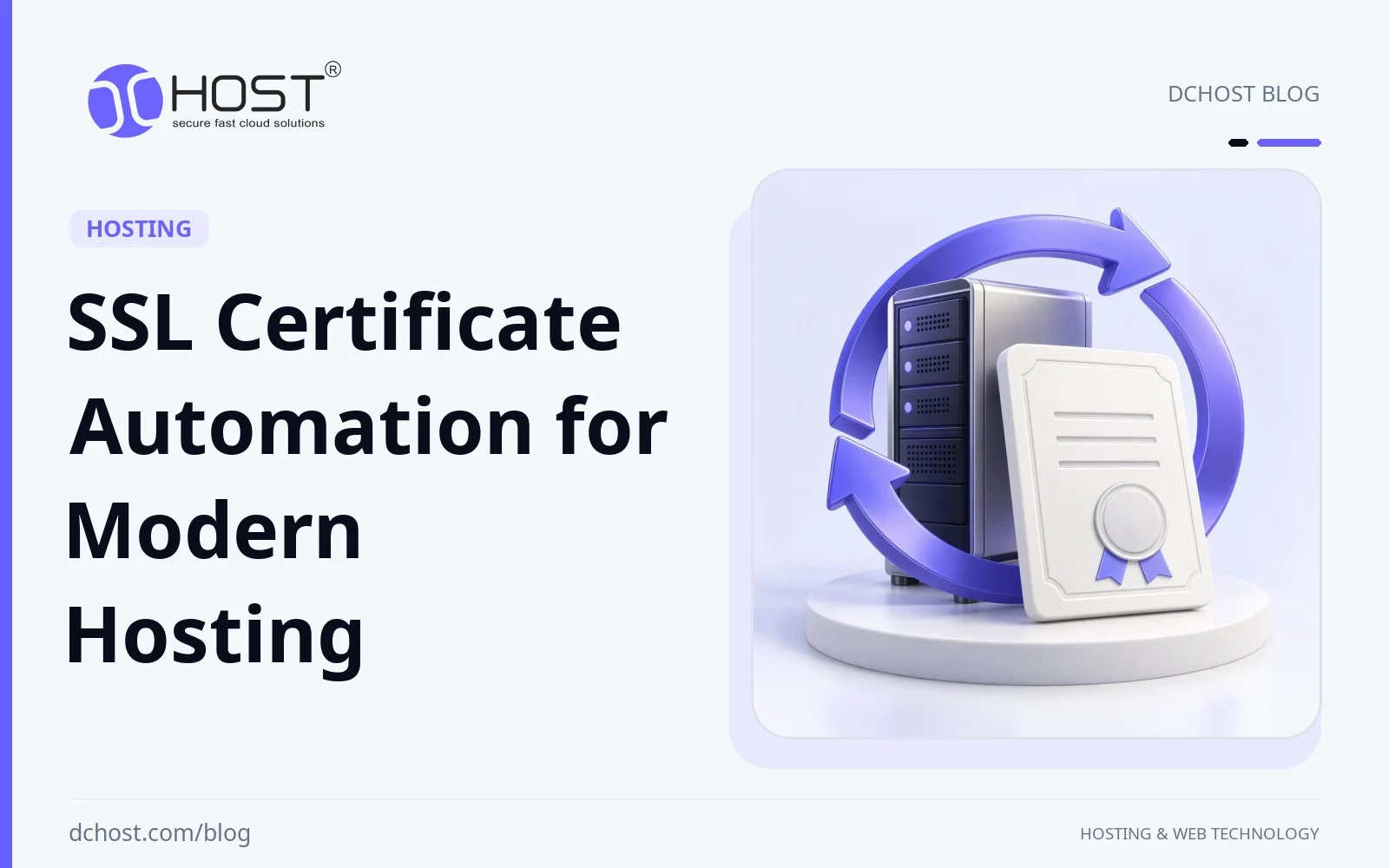
SSL certificates used to be a once-a-year chore: generate a CSR, send it to a certificate authority, copy-paste the CRT into your panel, and hope you did not break anything. Today that model simply does not scale. Certificate lifetimes are shrinking, sites span dozens of domains and subdomains, and many teams deploy several times a day. In that reality, manual SSL management is not just tedious; it is a direct availability and security risk. If a single certificate expires on a checkout subdomain or API, the entire business can feel it within minutes.
In this article, we will walk through how SSL certificate automation works, with the certificate-validity policy update dated below. We will look under the hood of ACME-based automation, explain how to automate issuance, renewal and deployment with monitoring, and identify operational responsibilities on shared hosting, VPS, dedicated servers and colocation. The goal is simple: help you reach a point where certificate renewals are boring, predictable and fully integrated into your normal deployment and operations workflow.
Why SSL Certificate Automation Became Essential
For publicly trusted TLS server certificates, the CA/Browser Forum had already adopted a shorter-validity schedule in April 2025. At this article’s original publication on 6 December 2025, the mandatory maximum was 398 days. Policy update checked on 4 November 2026: certificates issued from 15 March 2026 have a 200-day maximum; this falls to 100 days for issuance from 15 March 2027 and 47 days from 15 March 2029. These are upper limits, not a promise of a CA’s actual certificate lifetime or the length of a paid subscription. At the same time, architectures are getting more complex: microservices, separate frontend and API domains, staging environments, regional subdomains, and third-party integrations all expect valid HTTPS.
Trying to manage this manually quickly becomes unworkable:
- Each new domain or subdomain needs certificate coverage, whether through its own certificate, a SAN entry or a matching wildcard.
- Renewal dates fragment across the calendar, making tracking and reminders unreliable.
- Staff changes or lost documentation can leave you with certificates that no one knows how to renew.
- Operations teams spend time on repeatable, low-level tasks instead of higher-value work.
Automation reduces these risks. A well-designed SSL automation setup can:
- Request and validate certificates on demand when a domain is first provisioned.
- Renew certificates automatically long before they expire.
- Deploy renewed certificates and use supported graceful reloads, then check the served certificate and application availability.
- Standardise configuration so every site benefits from the same hardened defaults.
If you are curious about how SSL fits into the bigger picture of domains, DNS and hosting, our guide on how domain, DNS, server and SSL work together is a good background read.
How Modern SSL Automation Works Under the Hood
The ACME Protocol in Plain Language
Modern SSL automation commonly uses ACME, a standard protocol used by certificate authorities such as Let’s Encrypt and several commercial CAs.
At a high level, an ACME client running on your server or in your orchestration platform:
- Generates a private key and a certificate signing request (CSR).
- Asks the CA for permission to issue a certificate for a domain.
- Completes one or more challenges (HTTP-01, DNS-01, TLS-ALPN-01) to prove domain control.
- Receives the signed certificate chain from the CA.
- Installs the certificate into your web server or proxy and reloads it.
All of this can be driven by scripts, hooks or controllers, so routine renewals need no manual clicks. Failures still require monitoring and intervention. Certificate renewal does not guarantee private-key rotation: a renewal may reuse the existing key. If a key is compromised, obtain a certificate using a new key pair, revoke affected certificates and address the cause of the compromise.
Challenge Types and Why They Matter for Automation
The way you prove domain control to the CA determines how flexible your automation can be. The three common ACME challenges are:
- HTTP-01: The ACME client makes a challenge response publicly available under
http://yourdomain/.well-known/acme-challenge/...on port 80. This suits simple setups where the client can publish the response to every web frontend the CA may reach. - DNS-01: The client creates a special TXT record under
_acme-challenge.yourdomain. This is ideal for wildcard certificates and for situations where you cannot easily serve HTTP challenges from every endpoint. - TLS-ALPN-01: Validation uses a special TLS handshake on port 443. Choose this only where the TLS termination point supports the challenge; being behind a proxy is not sufficient.
We have an extended walkthrough of these options, with real-world pros and cons, in our article on ACME challenge types (HTTP-01, DNS-01 and TLS-ALPN-01). For serious automation, DNS-01 is often the most powerful, especially once you integrate it with your DNS provider’s API.
Agents, Hooks and Orchestration
On a single VPS or dedicated server, SSL automation is usually handled by a local ACME client. That client might be integrated into a control panel, run as a standalone binary, or be orchestrated via scripts and Cron/systemd timers. The important pieces are:
- Renewal loop: A scheduled job that checks expiring certificates and triggers ACME renewals.
- Deployment hooks: Scripts that install the newly issued certificate and reload Nginx, Apache, HAProxy or your application gateway.
- Failure handling: Logging, alerting and retry logic so a DNS glitch or temporary outage does not silently break automation.
In containerised or multi-node environments, the same logic is often expressed as a controller (for example, in Kubernetes) that watches for “Certificate” objects and reconciles the actual certificates with the desired state. The pattern is the same: declare what should exist, and let automation take care of the rest.
Key Advancements in SSL Certificate Automation
From Manual CSRs to Automated Issuance and Renewal
In a manual workflow, you generate a CSR, paste it into a web form, then download and install the certificate. An automated pipeline can instead handle these tasks:
- Certs are requested automatically when a site or vhost is first created.
- Renewals are triggered before expiry, with timing appropriate to the certificate lifetime and enough time to recover from failures.
- Configuration templates wire certificates to virtual hosts automatically.
- Use the server’s supported graceful reload procedure and verify its effect; uninterrupted service depends on the application and deployment.
Whether you use shared hosting, a VPS, a dedicated server or colocation, establish who configures and maintains issuance, renewal and deployment. In a managed setup, these may be platform responsibilities; in a self-managed setup, they belong in your operations workflow. Pointing a domain at a server alone does not configure SSL automation.
DNS-01 Automation and Reliable Wildcard Certificates
Automating wildcard certificates (like *.example.com) can reduce repeated certificate-management work across many subdomains. With ACME + DNS-01 and API-integrated DNS, your automation stack can:
- Request a wildcard covering subdomains that match its pattern, rather than every name in the zone.
- Rotate certificates without touching your web server configuration.
- Provision matching subdomains without requesting another certificate, provided the wildcard certificate is deployed to their TLS endpoints.
If you are running a platform with many subdomains (for example, per-customer or per-country sites), this is a game changer. We have a practical walkthrough of this pattern in our guide on hands-off Let’s Encrypt wildcard SSL automation with DNS-01.
Multi-CA and Fallback Strategies
Another important advancement is treating the certificate authority itself as a dependency that can fail. Rate limits, regional outages or policy changes at a single CA should not take down your platform. A robust automation stack can:
- Use one CA as the default and configure controlled fallback to another, ensuring that the fallback CA is permitted by any applicable CAA records and can complete validation.
- Spread issuance across CAs to reduce dependence on one CA’s limits, while respecting each CA’s rate limits and policies.
- Maintain a clear audit trail of which CA issued which certificate and when.
For an architecture using tools like acme.sh, our article on redundant ACME automation and CA fallback discusses fallback when Let’s Encrypt cannot issue a certificate because of rate limits or temporary issues. Treat fallback as a planned operational workflow, not an automatic consequence of supporting multiple CAs. If switching must be automatic, explicitly orchestrate failure assessment and CA selection. Prepare the backup CA account, validation access, CAA permissions, rate-limit handling, certificate-chain compatibility and deployment in advance. A backup CA will not resolve a failure in shared DNS or validation infrastructure.
Auto-SSL for SaaS and Custom Domains
SaaS platforms that let customers “bring their own domain” used to struggle with SSL at scale. Without automation, onboarding a custom domain can require a new certificate request and manual deployment. ACME can automate these steps; DNS-01 also requires a way to update or delegate the customer’s challenge records.
A well-designed SaaS can now:
- Detect when a customer adds a custom domain.
- Verify the customer’s control of the domain using a tenant-specific challenge, such as a unique TXT value, before assigning it to that tenant. A CNAME or A record pointing to the platform alone is not sufficient.
- Automatically complete ACME DNS-01 validation using authorised DNS API access or delegated challenge records that the platform can update for each renewal.
- Issue and bind a certificate to the correct ingress or load balancer route.
For more on this pattern in multi-tenant stacks, see our article on how DNS-01 ACME makes auto-SSL for SaaS custom domains scale without drama.
Kubernetes, cert-manager and Cluster-Level Automation
In containerised environments, SSL automation has moved one level up the stack. Instead of managing certificates server-by-server, you declare them as Kubernetes resources and let a controller handle the heavy lifting. Typical features include:
- Certificate resources that define which domains need HTTPS.
- Issuers and ClusterIssuers that describe how to talk to your chosen CA.
- Automatic secret creation and renewal for Ingress or custom controllers.
- Support for HTTP-01 and DNS-01 with various DNS providers.
When combined with a configured ingress setup (for example, Nginx, Traefik or Envoy) and the appropriate certificate resources, this can automate certificate issuance, deployment and renewal for declared hostnames. For clusters hosted on VPS or dedicated servers, this architecture keeps certificate management close to the workloads. Compute, storage and network responsibilities depend on the chosen hosting arrangement.
Smarter TLS Defaults and Security Features
Automation is not only about requesting and renewing certificates. It also gives you the chance to standardise the TLS settings themselves. Once you have one central place where certificates are deployed (for example, a reverse proxy layer), you can:
- Enable TLS 1.3 and phase out legacy protocols.
- Use modern cipher suites and perfect forward secrecy by default.
- Apply HSTS to sites ready for HTTPS-only access, and enable HTTP/2 or HTTP/3 where supported. Enable OCSP stapling only where the CA and certificate support it; Let’s Encrypt retired its OCSP service on 6 August 2025.
- Serve dual ECDSA + RSA certificates to balance performance and compatibility.
We have written separate deep dives on these topics, including how to enable TLS 1.3, OCSP stapling and HSTS on Nginx/Apache and using dual ECDSA+RSA certificates for speed and compatibility. Automation can make these settings consistent across compatible endpoints, but each setting still needs to suit the sites and certificates being served.
Designing a Robust SSL Automation Strategy
Choosing Where Automation Lives
When designing SSL automation, the first question is where the brains of the system should live:
- On a shared hosting platform: Often built into the control panel. Confirm whether the plan automates issuance, deployment and renewal, and which domains are eligible.
- On a single VPS or dedicated server: A local ACME client plus hooks and monitoring is usually enough.
- Across a fleet or cluster: A controller-based model (Kubernetes, centralised ACME service, or configuration management) makes more sense.
- In a colocation environment: You own the hardware; power, cooling, connectivity and any DNS services depend on the colocation agreement. Certificate automation runs as part of your own orchestration stack.
The smaller and more isolated the environment, the simpler you can keep things. As soon as you have many nodes or many domains, you will want a centralised approach.
DNS Integration and CAA Records
DNS is a critical piece of any SSL automation strategy, especially if you rely on DNS-01 challenges. For automated DNS-01 validation, your stack needs reliable programmatic access to create and delete challenge TXT records, directly or through delegation. That usually means:
- Using DNS APIs instead of manual changes in DNS panels.
- Separating public and private zones if you run split-horizon DNS.
- Managing credentials (API tokens) as secrets with proper rotation, and limiting their permissions to the DNS zones or challenge records the automation needs. Use challenge delegation where appropriate to avoid granting broader DNS access.
Do not forget about CAA records either. These tell the world which certificate authorities are allowed to issue certificates for your domains. Misconfigured CAA records can block issuance by your chosen CA; the absence of an applicable CAA record does not itself prohibit issuance. We have a dedicated deep dive on how to use CAA records correctly and combine them with a multi-CA strategy.
Rate Limits, Staging Environments and Testing
SSL automation must be tested like any other critical system. A few practical tips:
- Use staging CAs during development to avoid burning through production rate limits.
- Automate renewals in staging as well, so you catch challenge or DNS issues early.
- Group domains logically (for example, by project or environment) to limit the scope of a failed issuance or renewal.
- Watch Let’s Encrypt rate limits if you rely heavily on a single CA.
For a discussion of SAN certificates, wildcards and domain grouping as ways to manage certificate request volume, see our article on dodging Let’s Encrypt rate limits without breaking automation. For multi-tenant SaaS, separate certificates per tenant favour isolation and independent changes, but increase certificate counts and require rate-limit planning. Large SAN certificates reduce certificate counts, but adding or removing a name requires reissuance of the shared certificate and larger SAN lists increase certificate size. Prefer per-tenant certificates when isolation is the priority and the infrastructure can support them; schedule renewals with enough remaining validity and retry time rather than letting a fixed daily quota delay urgent renewals.
Monitoring and Alerting Around Certificates
Even with great automation, you should never rely on “trusting the script”. Basic operational hygiene includes:
- Metrics or periodic checks that alert you if any certificate is close to expiry.
- Logging of all issuance and renewal attempts, including challenge failures.
- Dashboards or reports showing how many domains are covered and by which CAs.
- Runbooks explaining manual recovery steps if automation fails.
If you already monitor uptime and HTTP status codes, adding certificate checks is a small but important extra layer. It is also wise to monitor DNS availability because propagation delays or misconfigurations can disrupt certificate validation. Our guide on DNS propagation and how to speed it up goes into this side of the story.
Common Pitfalls in SSL Automation (and How to Avoid Them)
DNS Glitches and Propagation Delays
DNS problems can prevent ACME validation. Examples include:
- Domains that are not yet pointing to the correct nameservers.
- TTL values that are so high that DNS-01 changes are not visible in time.
- Internal DNS zones that make local checks appear successful while the required TXT records are absent from public DNS.
Good automation checks DNS health before attempting issuance and has retry logic with backoff. It also keeps TTLs reasonably low for _acme-challenge records.
Missing or Incorrect Reload Hooks
Requesting and receiving a certificate is only half of the job. It must actually be loaded by the software terminating TLS. Deployment failures can occur when:
- Certificates are correctly renewed on disk, but Nginx or Apache is never reloaded.
- Old certificate paths are hard-coded in configuration templates.
- Multiple servers share a certificate, but only one of them gets updated.
Our rule of thumb: treat the reload step as a first-class citizen. Test it. Log it. If you deploy using CI/CD, make certificate deployment part of your pipeline and avoid mysterious manual side-steps.
Troubleshooting Browser Warnings and Mixed Content
Successful certificate issuance does not guarantee a working HTTPS experience. Browser problems can arise from application behaviour or certificate deployment. For example:
- Pages loaded over HTTPS that still pull images or scripts over HTTP (mixed content).
- Incorrect redirects between HTTP and HTTPS, causing loops or “Not Secure” labels.
- Outdated intermediate certificates or incomplete chains served by the web server.
We have a separate troubleshooting guide on fixing common SSL certificate errors, mixed content and browser warnings. When combined with automation, these practices keep both your certificates and your overall HTTPS experience clean.
Beyond Basic HTTPS: What to Automate Next
Mutual TLS (mTLS) Between Services
Once you are comfortable automating server certificates, the next logical step is mTLS — using certificates to authenticate both sides of a connection, not just the server. This is extremely powerful for:
- Microservices talking to each other inside a private network.
- Protecting admin panels and APIs that should only be accessible by known clients.
- Securing origin communication behind a CDN or reverse proxy.
We have shared practical ways to implement mTLS with Nginx and Caddy, including real configuration examples, in our articles on why mTLS matters between services and protecting your origin with authenticated origin pulls. Certificate rotation and deployment hooks apply here too, but issuance must support the server and client identities your mTLS trust model requires; do not assume an existing public HTTPS issuance workflow covers both.
Security Headers and HSTS at Scale
HTTPS is the foundation, but you can go further by standardising HTTP security headers across your sites:
- HSTS to enforce HTTPS in browsers after they learn the policy. Preloading requires a separate submission and acceptance process; confirm HTTPS readiness for all covered subdomains before including them.
- Content-Security-Policy (CSP) to control where scripts, images and other resources are loaded from.
- X-Frame-Options, X-Content-Type-Options and similar headers to block common attack vectors.
Common headers can be managed where you terminate TLS, with explicit header configuration alongside certificate deployment. Test policies per application rather than applying identical values everywhere: CSP must accommodate each application’s resources, and HSTS scope must match HTTPS readiness. Our guide on HTTP security headers, HSTS and CSP walks through a practical, incremental rollout strategy.
End-to-End Automation Across Environments
The last piece of the puzzle is integrating SSL automation into your broader deployment lifecycle:
- Use staging CAs to test issuance workflows, with TLS settings similar to production. Public CA staging certificates are not normally trusted by browsers; environments used for browser acceptance testing need certificates trusted by those clients.
- Production pipelines verify that the live HTTPS endpoint serves a valid, trusted certificate for the intended hostname before going live, rather than checking only that a certificate file exists.
- Infrastructure-as-code templates define which hosts require certificates, how they are requested, and where they are stored.
Treat SSL as part of your stack definition, alongside CPU, RAM, storage and DNS. Whether you deploy to shared hosting for a simple site or manage a complex SaaS on multiple VPS or dedicated servers, the pattern stays the same.
Bringing SSL Automation to Your Projects Without Drama
SSL automation has quietly transformed from a nice-to-have to a baseline requirement. Shorter certificate lifetimes, more complex architectures and rising security expectations all push in the same direction: manual certificate handling becomes harder to manage reliably and increases the risk of expiry or misconfiguration affecting uptime or trust. Modern tools and the ACME ecosystem can automate routine issuance and renewal, even for small teams, while monitoring and failure recovery still need clear ownership.
Start with clear decisions: where will your automation live (shared hosting, VPS, dedicated, cluster), which challenge types and CAs will you use, and how will DNS and monitoring be wired in. From there, aim for boring predictability: automatic issuance when a domain is added, safe renewals long before expiry, and centralised TLS settings that keep you aligned with current security recommendations. For the chosen hosting plan, verify who handles certificate issuance, renewal, deployment and failure alerts, and which DNS integrations are available.