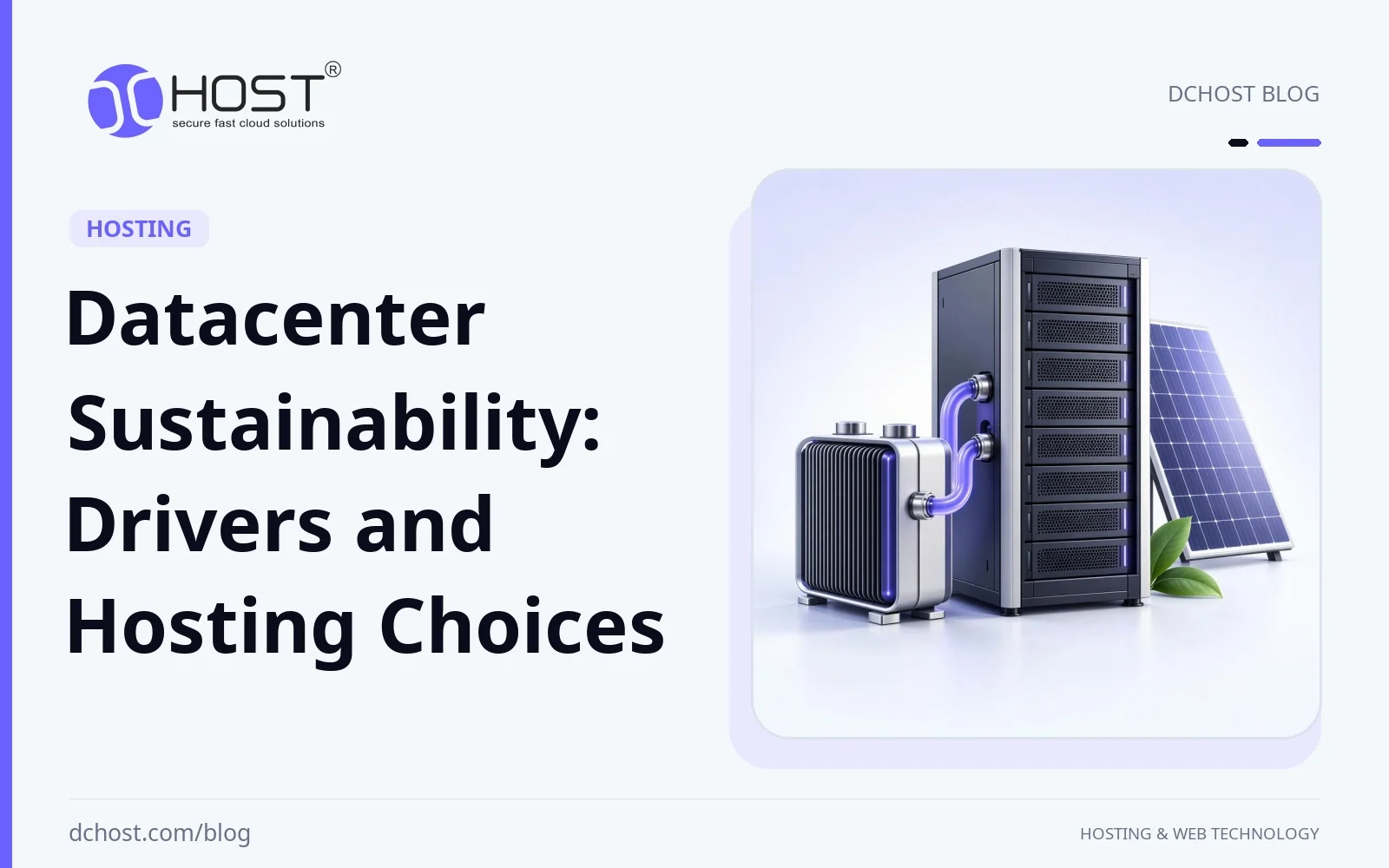
Datacenter sustainability belongs in infrastructure planning and procurement alongside performance, uptime, and cost. AI, video, gaming, SaaS, and always-on e‑commerce depend on physical infrastructure that uses energy, water, and hardware. Electricity prices, grid capacity, applicable reporting duties, and customer requirements can influence how facilities are designed, powered, cooled, and operated. Assessing these factors requires evidence about the specific facility and workload, rather than a broad promise of “green” hosting.
When comparing a VPS or dedicated server, sustainability involves concrete metrics like PUE, energy mix, cooling efficiency, and hardware lifecycle—not just “green marketing”. This article explains the main initiatives, how they affect hosting choices, and what to evaluate alongside performance and uptime.
Why Datacenter Sustainability Matters for Planning
Data centers need energy for IT equipment, cooling, and power distribution. Capacity constraints, electricity costs, reporting obligations, and customer requirements are practical reasons to assess that resource use.
Workload demand and grid capacity
Digital services—including AI inference, streaming, collaboration tools, remote work, and cloud‑based business systems—require compute and storage capacity. Concentrated data center loads can put pressure on local grids and transmission infrastructure, so connection capacity and timing should be checked for each proposed site. Reducing wasted energy helps make better use of available power, even when consolidation increases power use per rack.
Energy prices and long‑term cost control
Electricity is a significant data center operating cost. Higher prices increase the cost of wasted energy. Better cooling, power distribution, and server utilisation can support long‑term cost control, but investment decisions should compare expected energy savings with capital, maintenance, and operational costs. Sustainability initiatives can therefore serve both financial and environmental objectives without guaranteeing a payback.
Regulatory and reporting pressure
EU data center reporting was already mandatory by 2025 under Regulation (EU) 2024/1364. The scheme covers operators of EU data centers with an actual installed IT power demand of at least 500 kW per site—not planned design capacity or total corporate power use. Operators submit annual underlying data, including energy use and water input; the Commission calculates PUE (Power Usage Effectiveness) and WUE (Water Usage Effectiveness), rather than operators directly reporting those ratios. Water input follows the scheme’s data center boundary, excluding sanitary and other non-data-center uses. The Commission’s reporting announcement set the first deadline at 15 September 2024, followed by 15 May 2025 and 15 May each subsequent year. Its reporting FAQ explains the scope and calculation boundaries.
Corporate ESG (Environmental, Social, Governance) reporting has separate conditions: obligations depend on the entity, reporting year and applicable national law, not simply on using hosting or colocation. Where digital infrastructure is relevant to an enterprise’s reporting, it may need supporting information from providers. Credible energy and environmental data can therefore be a procurement criterion for customers with relevant reporting needs; the data center scheme does not itself impose a reporting duty on every hosting customer.
Customer and stakeholder expectations
For businesses with climate and sustainability objectives, digital infrastructure can be part of procurement assessments. Technology leaders can ask about renewable energy share, cooling technologies, certifications, and measured efficiency improvements alongside monthly price. For related evaluation criteria, see our sustainable data centers hosting evaluation guide. Demonstrably lower environmental impact can help distinguish providers alongside performance and price.
Core Pillars of Modern Datacenter Sustainability
Although sustainability is a broad topic, most serious data center initiatives fall into a set of practical pillars. Understanding these helps you evaluate providers and make better infrastructure decisions.
1. Energy efficiency and PUE improvements
PUE (Power Usage Effectiveness) is the most commonly cited efficiency metric. It is defined as:
- PUE = Total facility energy / IT equipment energy
A theoretical PUE of 1.0 would mean all facility energy goes to IT equipment, including servers, storage, and networking, with no facility overhead for cooling, power conversion, or losses. For illustration, PUE values of 1.8–2.0 mean total facility energy is 1.8–2.0 times IT energy; values of 1.2–1.3 represent less overhead per unit of IT energy. These are examples, not benchmarks for a facility’s age or design. Compare figures using defined measurement boundaries and periods, and consider climate and utilisation. PUE does not measure useful computing output, electricity carbon intensity, or water use.
Initiatives that can improve PUE or reduce total energy use include:
- Optimised airflow management: Hot/cold aisle containment, blanking panels, and well-designed rack layouts reduce mixing of hot and cold air and can reduce cooling-system energy use without reducing the heat generated by IT equipment.
- Variable-speed fans and pumps: Instead of running cooling equipment at full speed all the time, variable-speed controls adjust power use to real cooling demand.
- Efficient UPS and power distribution: Compare UPS systems and power supplies at expected operating loads; higher conversion efficiency and suitable operating modes can reduce wasted energy. Newer equipment alone does not guarantee lower losses.
- Server utilisation improvements: Better consolidation and virtualisation can reduce idle power by using fewer physical servers. This can lower total energy use without improving PUE: the ratio may rise if IT energy falls faster than facility overhead.
Energy efficiency can align environmental and cost objectives. Reducing wasted electricity lowers energy demand and can reduce operating costs; the emissions benefit depends on the electricity supply, and the overall benefit should account for any replacement equipment or additional resource use.
2. Renewable and low‑carbon energy sourcing
At a fixed IT energy demand, improving PUE reduces total facility energy use; renewable sourcing addresses the electricity supply rather than the amount consumed. Modern initiatives typically use a mix of:
- On‑site generation: Rooftop or nearby solar, and sometimes small‑scale wind, supplement grid power. On‑site capacity rarely covers all demand; peak reduction depends on when generation coincides with load and whether storage is available. Fuel cells are another on‑site option, but their carbon impact depends on the fuel and how it is produced.
- Power Purchase Agreements (PPAs): Long‑term contracts with renewable generators (solar, wind, hydro) can provide price predictability and help finance new generation. Benefits depend on contract terms and the project; a PPA does not by itself guarantee new capacity or round‑the‑clock renewable supply to the facility.
- Grid mix optimisation: Locating data centers in regions with cleaner electricity grids (more hydro, wind, or nuclear) effectively lowers the carbon intensity of each kWh consumed.
Grid demand response programmes are another option to evaluate: eligible operators may temporarily shift or reduce non‑critical workloads when grids are stressed. Assess programme rules, service constraints, and any backup generation or later rebound in electricity use before claiming grid or emissions benefits.
3. Cooling innovation: from free cooling to liquid solutions
Cooling contributes to non‑IT energy use. Higher rack power density can make air‑only cooling harder to design efficiently. Options to evaluate against the intended density, climate, and operating conditions include:
- Free cooling and economisation: In suitable climates, outside air or evaporative techniques can reduce compressor usage. Evaluate operating hours and water requirements for the chosen design.
- Higher allowable inlet temperatures: Where the installed equipment’s specified operating limits permit, higher inlet temperatures can reduce over‑cooling. The energy benefit depends on the cooling system and any increase in server fan power.
- Rear‑door heat exchangers: These mount directly on racks to capture and remove heat close to the source. They can improve cooling efficiency, depending on the design and the energy needed for coolant circulation and heat rejection.
- Liquid and immersion cooling: For high-density workloads such as AI and HPC, direct‑to‑chip liquid cooling or immersion systems can support heat removal where air alone is difficult to use. Compare total cooling energy, water use, equipment compatibility, and maintenance needs rather than assuming a net efficiency gain.
When evaluating data center cooling, consider how well the design supports the intended rack density and how much energy it uses to remove heat under expected operating conditions.
4. Circular hardware lifecycle and e‑waste reduction
Sustainability does not stop at the power meter. Manufacturing servers, storage, networking gear, and batteries creates embodied emissions and uses materials. Premature disposal can waste those resources, while retaining inefficient equipment also has operating impacts. Assess both sides over the intended service life rather than assuming replacement or continued use is always better.
Modern initiatives focus on a circular lifecycle for IT equipment:
- Right-timed refresh cycles: Balance the operational energy savings of newer hardware against the embodied carbon of replacement equipment and the remaining useful life of existing systems, rather than replacing hardware simply because a calendar date arrives.
- Reuse and redeployment: Older but still efficient servers can be redeployed to less demanding workloads, lab environments, or backup infrastructure, provided they still meet security, support, and reliability requirements.
- Certified refurbishment and resale: Instead of scrapping decommissioned hardware, partnering with refurbishers extends its useful life for other organisations.
- Responsible recycling: Where reuse is impossible, certified e-waste recyclers recover valuable materials while minimising environmental harm.
Before transferring or disposing of data-bearing equipment, apply and verify a media-appropriate sanitisation process, preserve required records and recovery copies, and document the disposition. Where secure reuse is not possible, use appropriate physical destruction and recycling. Reuse must not expose the previous owner’s data.
For hosting customers, migrations to newer platforms can improve performance per watt. However, upgrading CPUs or storage is not itself a circular hardware practice: the assessment also needs to consider the impacts of manufacturing replacement equipment and whether retired hardware is reused, refurbished, or responsibly recycled.
5. Location, water, and building design
Where a data center is built and how the building is designed also matter:
- Climate‑aware siting: Cooler climates can support more free cooling; regional hazards should inform resilience planning rather than serve as a blanket reason to reduce redundancy.
- Water use and Water Usage Effectiveness (WUE): Cooling systems that rely heavily on water can stress local resources. Assess water availability, total water input, and WUE using a stated measurement method, boundary, and period. A water-saving design may have an energy trade-off, so review both together.
- Efficient building envelope: Insulation and shading can reduce external heat loads where relevant; assess their contribution alongside internal IT heat loads and airflow design.
- Automation and monitoring: Fine‑grained telemetry for power, temperature, and humidity enables tuning of setpoints and operations for efficiency.
For an overview connecting physical infrastructure with service selection, see Datacenter Sustainability: From Facilities to Hosting. It covers power, cooling, hardware lifecycle, and hosting choices. The key takeaway: assess these decisions together over the service life, because an improvement in one area can change resource use elsewhere.
Software and Architecture: Workload Efficiency
Sustainability is not only a facilities problem involving power, cooling, and buildings. Software architecture and capacity planning influence how much infrastructure a service needs. Poor utilisation and unnecessary application work can waste resources even in an efficient facility.
Right‑sizing workloads and avoiding over‑provisioning
Provisioning servers “just in case” can leave substantial unused capacity. Monitoring and capacity planning help you choose VPS or dedicated server sizes based on expected demand and scale as requirements change.
For capacity-planning guidance, see how to estimate traffic and bandwidth needs on shared hosting and VPS. The same thinking applies to CPU, RAM, and storage: measure real usage, add a reasonable buffer for peaks and growth, and avoid unnecessary idle headroom. Right‑sizing can reduce costs and enable lower energy use when it allows physical capacity to be consolidated or powered down.
Consolidation, virtualisation, and containerisation
Modern hypervisors and container platforms can run many workloads on a single physical host while maintaining isolation. When it allows surplus hosts to be powered down, this consolidation can:
- Raise average utilisation of physical servers
- Reduce the number of machines drawing idle power
- Improve efficiency of shared components (power supplies, fans, cooling infrastructure)
Workload placement should balance consolidation with peak demand, isolation, and failover capacity. Containerisation, orchestration, and smarter scheduling can help reduce hardware sprawl, but their energy benefit depends on workload behaviour and the physical capacity that can actually be retired or powered down.
Application‑level optimisation
Not all energy savings come from infrastructure. Better application design can dramatically reduce CPU and I/O consumption per request. Examples include:
- Caching: Full‑page caching, object caching (Redis/Memcached), and query caching reduce repeated work.
- Efficient database queries: Well‑indexed schemas and optimised queries cut CPU time and disk I/O.
- Static asset optimisation: Compressing images, using modern formats like WebP/AVIF, and leveraging CDNs to serve content closer to users.
For storage-performance context, see our NVMe VPS hosting guide to storage interfaces, IOPS, and I/O wait. Faster storage, when paired with efficient applications and caching, may let fewer servers handle a storage-limited workload. Whether this improves sustainability depends on total energy use and hardware lifecycle impacts, not throughput alone.
Smarter data management and retention
Storing and backing up data is not free from an energy perspective. Storage infrastructure consumes power, and backup jobs use processing and I/O resources; remote backups also use network bandwidth. Energy use does not scale directly with each stored GB. Realistic retention policies should balance recovery needs, applicable obligations such as KVKK/GDPR requirements, and storage costs rather than encourage unnecessary data hoarding. Less data stored and replicated can shorten backup windows and reduce future capacity needs. Physical energy savings depend on whether storage devices can be powered down or avoided, not simply on deleting files.
Evaluating a Hosting Provider’s Approach to Datacenter Sustainability
Hosting providers sit at the intersection of data center infrastructure and customer applications. Evaluating their sustainability approach means considering both facilities and hardware, and the tools or guidance available to help customers use resources efficiently.
Choosing efficient, sustainability‑focused data centers
When evaluating data center options, look beyond power and space pricing. Useful criteria to assess and revisit include:
- PUE targets and historical performance: Look for facilities with a clear track record of PUE improvement and transparent reporting.
- Energy mix and renewable commitments: Assess the documented energy mix and the scope of renewable commitments, including PPAs or on‑site generation.
- Cooling strategy: Modern cooling designs, hot/cold aisle containment, and use of free cooling where climate allows.
- Hardware lifecycle practices: How decommissioned hardware is handled, and whether the facility supports circular lifecycle and responsible recycling.
These criteria should be revisited during capacity planning and expansion, rather than treated as one‑time checkboxes. For a complementary operational approach, see Data Center Sustainability: Measure, Improve, Repeat, which connects facility and workload measurements with practical improvement options.
Evaluating hardware and storage efficiency
Hardware choices should balance performance with efficiency for the intended workload. Options to evaluate include:
- CPUs selected for measured performance per watt on the intended workload, rather than generation alone
- NVMe SSDs for storage‑intensive workloads where latency or I/O wait limits useful throughput; compare energy per unit of work rather than assuming an interface guarantees efficiency
- High‑density configurations where appropriate, to reduce the number of physical nodes needed for a given capacity while preserving cooling and resilience requirements
When evaluating VPS or dedicated server hardware upgrades, compare useful work per kWh under representative loads, not just peak benchmarks. A lifecycle assessment should also account for manufacturing impacts, expected service life, and reuse of retired equipment; operating efficiency alone does not establish overall sustainability.
Helping customers run workloads efficiently
Even efficient hardware can be wasted by unnecessary software work. Use Hosting Sustainability: Assessing Provider Evidence to connect provider claims to a defined site, period, and method. Complement that procurement assessment with application-level profiling and optimisation for stacks such as WordPress, WooCommerce, and Laravel, measuring the resources each request consumes.
For a new project—whether a VPS for a SaaS app, an e‑commerce deployment on a dedicated server, or a colocation setup—size the environment using measured workload patterns or representative load estimates, with headroom for peaks and growth. This helps avoid both under‑provisioning, which harms performance, and excessive over‑provisioning, which raises costs and can waste physical capacity.
What You Can Do to Support Sustainable Hosting Today
Sustainability is a shared responsibility between providers and customers. The good news: you do not need a separate “green IT” project to make progress. Many of the best steps also improve performance, reliability, and cost predictability.
Ask the right questions when choosing infrastructure
When evaluating hosting or colocation options, consider adding sustainability questions to your checklist:
- What is the typical and target PUE of the data centers used?
- What share of energy comes from renewable or low‑carbon sources?
- Which cooling technologies are used, and how are they being modernised?
- How is hardware lifecycle managed—reuse, refurbishment, recycling?
- Are there public reports or certifications related to energy management or sustainability?
Transparent, documented answers help you assess the scope of an initiative rather than relying on a “green” label. For a related overview, see the Turkish-language guide to data center sustainability, infrastructure, and hosting. It considers energy, water, hardware, and hosting decisions together.
Design applications with efficiency in mind
On the software side, you can often reduce your footprint by reusing existing best practices:
- Use HTTP caching headers and CDNs to offload static content closer to users.
- Implement database indexing and query optimisation to cut redundant processing.
- Review cron jobs and background workers so they run at appropriate intervals rather than constant polling.
- Profile and remove inefficient code paths that burn CPU without adding user‑visible value.
If you run common stacks like WordPress, WooCommerce, or Laravel, performance tuning may help you get more throughput out of the same VPS or dedicated server. Measure the effect on your workload before reducing capacity.
Right‑size, then iterate
Instead of buying the biggest server you can afford “just in case”, we generally recommend starting with a realistic configuration and watching how it behaves under load. With proper monitoring in place, you will see when CPU, RAM, or storage IOPS become bottlenecks and can scale up or out accordingly.
The goals of this approach are to:
- Spend less on unused capacity
- Increase average utilisation while retaining headroom for peaks and failures
- Use monitoring to identify bottlenecks before adding capacity
From a sustainability perspective, right-sizing can reduce idle capacity. Physical energy savings depend on whether resources are actually consolidated or powered down; reducing a virtual allocation alone does not establish a reduction in data center power use.
Align retention and backups with recovery and compliance needs
Backups and archives are essential, but “keep everything forever” can waste storage and conflict with retention obligations. Implement clear policies for how long you keep logs, database backups, and file archives, especially for customer‑generated content. Techniques like incremental and deduplicated backups, object storage with lifecycle rules, and periodic pruning of obsolete data can reduce storage demand and cost. Energy savings depend on the implementation and underlying infrastructure. Retention and deletion rules must preserve required recovery points, backup dependencies, and legally required records.
Planning Ahead: Evidence, Obligations, and Practical Next Steps
For future capacity and procurement decisions, keep three areas under review:
- Comparable reporting: Request PUE, water, and electricity-sourcing information with defined sites, periods, and methods. Standard labels alone do not make figures comparable.
- Applicable obligations: Check current requirements for the jurisdiction, facility, and reporting entity. Distinguish adopted rules from proposals, and do not infer a universal minimum-PUE duty from the EU reporting scheme.
- Coordinated purchasing: Involve technical, financial, and relevant sustainability or compliance stakeholders so environmental criteria are assessed alongside performance, recovery, and cost requirements.
When assessing a provider’s long‑term plans, ask how hardware refresh decisions weigh efficiency gains against continued use of existing equipment, how data center operators plan to improve energy and cooling efficiency, and what information is available about the footprint of your hosting choices.
If you are planning your next project—whether it is a new e‑commerce site, a SaaS platform, or a migration from legacy infrastructure—now is an excellent moment to weave sustainability into your decisions. Choose locations and service types with efficiency in mind, design your architecture to do more with less, and ask your provider clear questions about how their data centers are evolving. Compare VPS, dedicated server, and colocation options against your workload, capacity headroom, and operational responsibilities, alongside the provider’s documented sustainability information.