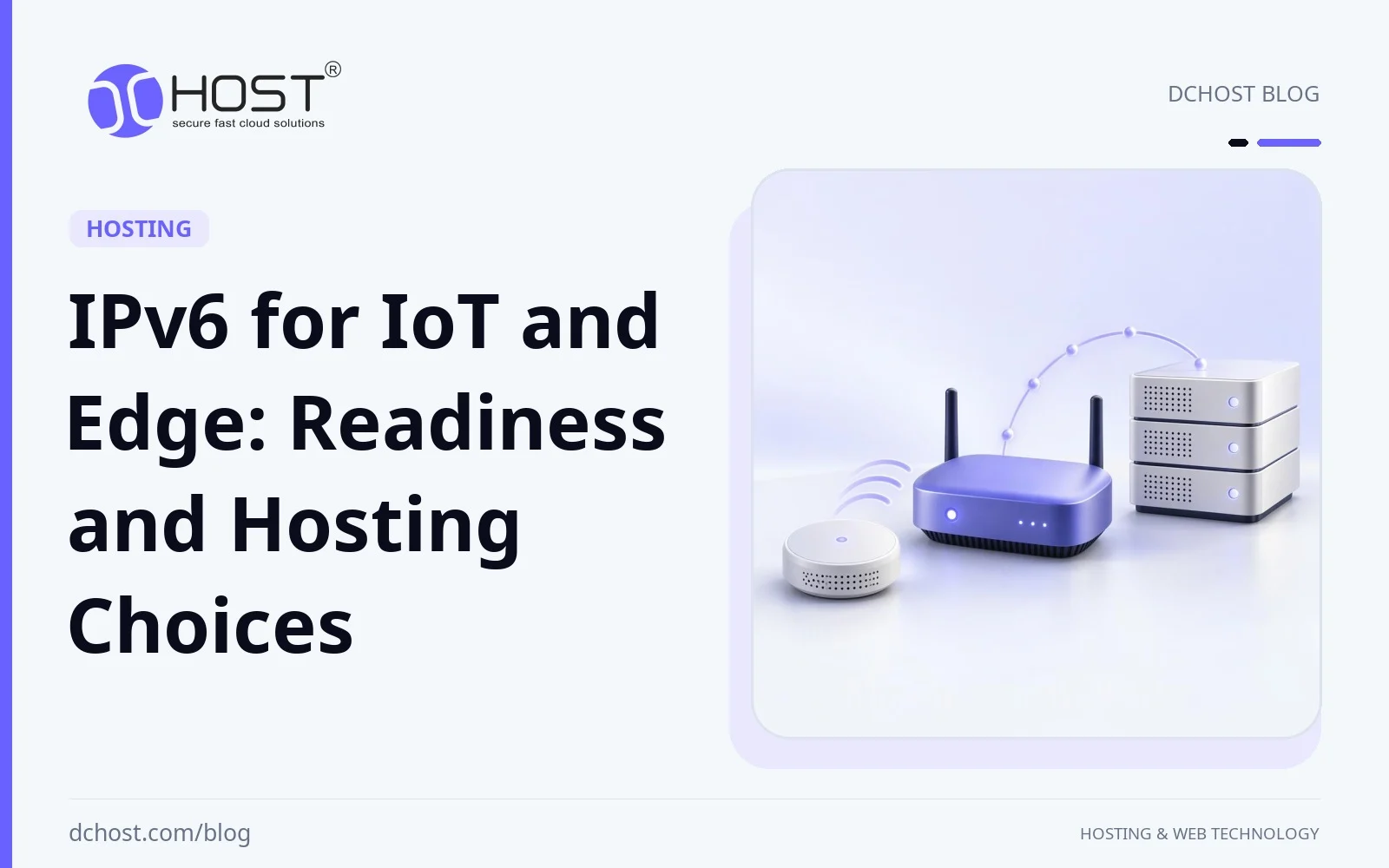
IPv6 Readiness Starts with the Device-to-Service Path
For an IoT or edge deployment, enabling IPv6 on a public API is only one part of readiness. A sensor may use a constrained local network, a gateway may translate an application protocol, and the cloud endpoint may expose both IPv4 and IPv6. The useful question is which parts of that chain support the intended design and who can diagnose or reverse a failed change.
This guide develops a staged IPv6 adoption plan for device fleets, gateways and the services that operate them. It covers capability inventory, dependency ownership, security, representative pilot tests and the evidence needed to expand. The examples are planning templates, not reported DCHost customer deployments or measured performance results.
Separate Address Capacity from Device Capability
IPv6 expands IP addresses from 32 to 128 bits, giving operators more room for a structured address plan. That does not guarantee that a particular sensor, modem, firmware version or management tool can use it. A globally routable address also does not mean a device should accept unsolicited internet connections. Addressing, application identity and access policy are separate decisions.
RFC 7228’s constrained-node terminology describes limitations in memory, processing, power and network capacity. Some very constrained devices participate through a proxy or gateway; others can run an IP stack designed for their constraints. Its historical device classes are rough capability categories, not a current purchasing checklist. Assess the actual hardware and firmware instead of assuming that every connected device can run the same stack as a server.
IPv4 allocation constraints can motivate a review, but they do not establish the business case by themselves. Regional registries have different limited-allocation, waiting-list and transfer rules, and address prices vary. Use the guide to IPv4 address pricing and network budgets as context, then cost the addresses, gateway capacity, software work and continuing support your own design needs.
Public adoption charts are also context rather than a fleet readiness test. The RIPE NCC network trends analysis can inform planning questions, but a regional average does not establish the capabilities of your carrier contract, private network or device model. Confirm any procurement requirement in the applicable policy or contract.
Adoption Drivers and Regional Context for a Fleet Plan
Address pressure, network investment and procurement requirements can create different reasons to adopt IPv6. RFC 9386, published in April 2023, describes IPv4 scarcity affecting carrier and content-provider decisions, including wireless networks, and government actions in particular countries. Those are documented historical drivers, not proof that every current carrier contract supplies IPv6 or that every organization faces a mandate. Check the applicable service and procurement requirements.
For a growing fleet, compare the address plan and gateway or translation capacity with the cost of device, application and operational changes. A mobile network’s access design, a public hosting endpoint and a private device network can progress at different speeds. A supported dual-stack CDN edge can help serve IPv6 clients while the origin remains IPv4; it does not establish native IPv6 on the device path. Existing firmware and application dependencies still need the inventory below.
Compare Countries and Networks with the Same Measurement
The APNIC measurement map separates IPv6-capable and IPv6-preferred rates and reports sample counts. In its 30-day window from 5 October to 3 November 2026, the selected country samples below show substantial variation. These are country examples, not averages for Europe, Asia or Africa, and not a share of all internet traffic.
| Country | IPv6 capable | IPv6 preferred | Samples |
|---|---|---|---|
| France | 85.98% | 84.87% | 21,793,199 |
| India | 76.44% | 73.66% | 108,713,839 |
| Turkey | 22.02% | 21.04% | 15,144,848 |
| South Africa | 4.37% | 4.23% | 4,755,727 |
Higher-capability samples can justify including IPv6 early in a public-service pilot. Lower-capability samples reinforce the need to preserve access for the actual IPv4 clients in scope. Neither establishes what a particular enterprise network or IoT carrier profile supports, and a single window does not prove growth. Compare the same metric, country or ASN and time window before describing a trend; test the specific networks that serve your users and devices.
Why Enterprise and Access-Network Rollouts Can Differ
RFC 9386’s 2023 enterprise assessment identifies private addressing and proxies that reduce immediate IPv4 pressure, limited budgets, application conversion, training needs and security or management concerns as barriers. A consumer access network can therefore support IPv6 while a corporate application or industrial segment remains IPv4-only. This historical assessment explains planning obstacles; it does not measure current enterprise adoption.
Turn those obstacles into an owned work list: record the application or firmware dependency, required tooling or training, business reason, acceptance evidence and recovery owner. A public dashboard can gain a tested dual-stack edge while legacy devices retain a documented gateway boundary. The goal is to close a specific service gap without claiming that a country average proves readiness or that IPv6 necessarily makes a route faster.
Map Each Hop and Assign an Owner
Draw the actual path from device to gateway, broker or API, storage and operator console. Add the paths used to provision, update, monitor and recover the device. Distinguish a gateway that routes IPv6 from one that terminates the device protocol and opens a separate upstream connection. An IPv6-capable upstream connection does not prove that the device itself uses IPv6.
| Path or component | Evidence to collect | Responsible role |
|---|---|---|
| Device and local link | Hardware model, firmware version, IP or non-IP transport, supported addressing and recovery behavior | Device or firmware owner |
| Gateway and site network | Routing or proxy function, prefix assignment, firewall policy, resource limits and rollback access | Site and network owner |
| Carrier or upstream link | Actual IPv4/IPv6 service, DNS behavior, translation dependencies and reconnection tests | Connectivity owner |
| Broker, API and storage | Listeners, authentication, IPv6 parsing, backend dependencies and expected application responses | Application owner |
| Management and operations | Provisioning, firmware distribution, time synchronization, alerting, logs and remote recovery path | Operations owner |
For each row, record the current state, desired state, test evidence and unresolved dependency. “Supported” in a product brochure is useful input, but the acceptance record should identify the exact version and configuration tested. Include vendor support status and a review date for equipment that cannot be upgraded.
Do not infer the device-to-cloud path from the radio generation alone. A 4G or 5G modem may be used with different network profiles and address-family arrangements. Check the actual connection. Native IPv6 can avoid some IPv4 translation, but latency and reliability still depend on the route, gateway and application workload.
Choose the Compatibility Boundary Deliberately
IPv6 devices with a supported routed path
Where devices and network equipment support native IPv6, plan prefixes and subnet boundaries with the network provider and record how addresses are assigned. Check service discovery, DNS, default-route behavior and changes after a reconnect or renumbering event. Avoid hardcoded assumptions about a permanent prefix or one universal assignment mechanism.
Application identity should survive an address change. Use the authenticated device identity that the platform is designed to verify, such as a provisioned credential, and manage its lifecycle separately from the network address. IPv6 temporary addresses can change; even a stable address is not proof that the expected device or user is presenting it.
Constrained or legacy devices behind a gateway
A gateway may allow an existing device protocol to remain in use while the upstream connection changes. Document where protocol termination, buffering, authentication and access control occur. The gateway becomes an operational dependency: test its capacity and recovery rather than assuming that an IPv6 upstream interface makes the whole fleet independent of it.
If the device uses a non-IP protocol, describe that segment accurately. If it uses only IPv4, record the retained IPv4 boundary. Neither arrangement is evidence of end-to-end native IPv6. A gateway can be a deliberate compatibility choice while an upgrade or retirement plan proceeds.
IPv6-only segments with IPv4 dependencies
Stateful NAT64 and DNS64 can support suitable IPv6-initiated access to IPv4 servers. DNS64 synthesizes an IPv6 answer from an IPv4 DNS record; it does not make every application protocol compatible. Test hardcoded IPv4 destinations, addresses embedded in application messages, resolver behavior and DNSSEC validation arrangements.
The usual outbound translation setup does not automatically expose an IPv6-only broker or API to IPv4 clients. A dual-stack listener, application proxy or another explicitly designed ingress path may be required. Keep translation capacity and failure monitoring in the inventory. The comparison of IPv6-only and dual-stack hosting helps separate public compatibility from internal addressing.
Apply Security Policy to Devices, Gateways and Services
Inventory intended listeners and restrict management access before enabling a new path. Preserve the same access goals across IPv4 and IPv6, with rules appropriate to each protocol. Do not copy IPv4 rules mechanically or open a broad source range just to make a failed test pass. Globally unique addresses do not replace authentication, segmentation or updates.
RFC 9099’s operational security guidance covers Neighbor Discovery and other IPv6-specific considerations. On managed links, review router advertisements, neighbor discovery and the protections your equipment supports. Required ICMPv6 messages, including Packet Too Big for path MTU discovery, need appropriate treatment; blanket blocking can break communication. Apply controls at the relevant link or boundary, rather than allowing every control message everywhere.
Check both successful and rejected operations: a permitted device should reach its intended broker, an unauthorized device should not inherit access merely from an address, and a management interface should remain restricted. Include the reverse proxy, WAF and rate limits where an HTTP API uses them. The guide to DDoS protection for websites addresses the public application layer; it does not cover every device or local-link control.
Changing source addresses also affect abuse controls and logs. A per-address rule can miss repeated activity across temporary addresses, while an overly broad prefix rule can block unrelated devices or users. Combine appropriate network controls with authenticated identity and application behavior, then inspect legitimate failures during the pilot.
Test a Representative Cohort Before Expanding
Choose a recoverable pilot that represents the hardware, firmware, gateway and connectivity combinations you intend to deploy. Low device count does not by itself mean low impact: a safety-critical sensor or an alarm gateway may need a different test environment and change process. Name the rollback operator and confirm that recovery access does not depend entirely on the path being changed.
RFC 7381’s enterprise deployment guidance recommends preparation and assessment, followed by phases chosen for the organization’s dependencies and priorities. It does not prescribe one mandatory order for every network. Your pilot should produce evidence for the next cohort, not merely prove that one demonstration device connected once.
| Scenario | Test coverage | Recorded result |
|---|---|---|
| Initial provisioning | Addressing, DNS, device authentication and intended broker or API | Device/version, network profile, expected response and actual outcome |
| Normal workload | Representative telemetry, command delivery if used, and application acknowledgements | Success/failure counts, timing and workload definition |
| Disconnection and recovery | Gateway restart, link loss, device wake-up and reconnect behavior | Recovery time, queued-data handling and any duplicate or missing application records |
| Address or prefix change | Discovery, allowlists, device identity and management reachability | Which dependencies refreshed correctly and which retained stale state |
| Update and maintenance | Firmware download, integrity/authenticity checks, deployment recovery and operational alerts | Observed update result and documented recovery procedure |
| Protection and rollback | Authorized/unauthorized access, both address families where retained, and restored configuration | Policy result, rollback operator and remaining restrictions |
Set acceptable error rates, response times, recovery behavior and resource use from the application’s requirements before the pilot. The table contains no measured results or universal thresholds. For a sleepy or battery-powered device, include the relevant wake-up and operating cycle; an always-connected laptop is not a substitute. Test realistic message sizes and update transfers as well as small probes.
For protocols with retries or buffered telemetry, inspect the application outcome after a disruption. Record missing, delayed or duplicate messages according to that protocol’s expected behavior, rather than judging success from a single transport connection. If a network or address-family change affects power use, measure it on the actual device and workload before claiming an improvement.
Test Hosting and Public Endpoints Separately
The broker, dashboard or HTTP API may run on a VPS, a dedicated server or another platform. Confirm IPv6 support, assigned addressing, routing and management responsibilities for the specific product and location. Do not infer those details from a provider-wide statement.
For an HTTP service, prepare routing, listeners, TLS, firewall policy and per-family monitoring before publishing AAAA. Test the intended hostname and certificate against the proposed IPv6 endpoint from an external IPv6-capable network. A successful ping or a browser extension does not establish that path. A CDN can use IPv6 at the client edge while keeping an IPv4 origin; test each leg separately. For public websites, verify that HTTPS, redirects and canonical URLs behave consistently over both address families.
The dual-stack AAAA and connectivity playbook and VPS IPv6 configuration guide cover that server work. Use the website IPv6 pilot guide for a public dashboard or site. Retain required IPv4 dependencies until a tested alternative exists.
Keep certificate renewal, outbound APIs, webhooks, DNS, time synchronization, backups and management connections in the dependency record. Support in a framework does not prove that its libraries, database fields or external services handle IPv6. Review manual IP parsing, IPv4-only expressions, fixed-width fields and allowlists; use IP-aware parsing rather than splitting addresses on colons.
Compare Hosting Patterns for Devices and Applications
The following are planning examples, not reports of DCHost customer deployments. They address different starting points and can be combined; they are not mandatory stages. Compare the public client path, backend and device dependencies, operational access and recovery evidence before choosing a boundary.
Dual-stack edge with a mostly IPv4 interior
An existing business can make a supported web endpoint, dashboard or public API available over both IPv4 and IPv6 while keeping its internal services and databases on IPv4. A dual-stack reverse proxy or load balancer can bridge those separate connections when the product supports that arrangement. This preserves the internal addressing plan for the first phase; it does not require every backend or legacy application to be re-addressed at once.
Document the edge-to-origin family and management path. Existing internal ACLs may remain in place, but the new public IPv6 listener, proxy trust, firewall, TLS and logging still need review and testing. This is not an automatic speed or security improvement. Add IPv6 to monitoring, backups or links between sites only as a separately tested step. Email can remain on its validated IPv4 path until a distinct SMTP readiness review justifies a change.
Greenfield IPv6-first SaaS and API services
A new SaaS platform or API supporting an IoT fleet can choose IPv6 for internal service discovery and service-to-service traffic when the platform, libraries and dependencies support it. Public APIs and dashboards can retain dual-stack entry points for IPv4-only customers. Document prefix allocation and subnet ownership, and inventory legacy services or external APIs that still require IPv4 or a supported translation path.
A new design offers an opportunity to avoid carrying forward unnecessary overlapping private-IPv4 networks or NAT arrangements, but neither savings nor simpler operations are guaranteed. Verify discovery, client-IP parsing, allowlists, egress, telemetry and recovery before removing IPv4 from any segment. Keep public compatibility and internal IPv6 readiness as separate acceptance decisions; a successful IPv6 device connection does not prove that every third-party API will work.
IPv6-only labs and testbeds before production
An isolated IPv6-only lab on a suitable VPS, dedicated server or other test platform can reveal hidden IPv4 dependencies before a production change. Reproduce representative application calls, service discovery, TLS termination and renewal, logging, monitoring and failover. Include the network, security and application owners who would operate the service, and use test credentials and non-production data.
Keep a documented recovery or management path and record which dependencies needed DNS64/NAT64, a proxy or another compatibility arrangement. A lab with the right result is evidence for the next representative pilot, not approval for an entire production fleet: production carriers, device firmware, traffic and external services may differ. Confirm the hosting plan’s actual IPv6 and management support rather than assuming the provider offers a prebuilt lab service.
Measure Fleet Progress without Confusing Addresses and Devices
Report the tested cohort by model, firmware, gateway and network profile. Define the denominator: devices in scope, devices tested and devices that met the stated criteria are different counts. Record exclusions and unresolved dependencies. A high IPv6 traffic share can coexist with an untested recovery path or a small group of failing devices.
Separate device-to-gateway, gateway-to-service and client-to-dashboard telemetry. A cloud log may show a gateway or proxy address shared by many devices; an IPv6 address may change during a device’s lifetime. Use the platform’s verified identity and inventory records for fleet attribution. Trust forwarded client-IP fields only from the intended proxy chain.
Check that collectors, databases, SIEM queries and dashboards preserve and parse IPv6 correctly. Define retention, access and data minimization for the information you actually need. IP masking or pseudonymization alone does not establish GDPR or KVKK compliance. The guide to IPv6-aware log masking and privacy controls provides related logging considerations.
If operators also use website analytics, keep those sessions separate from device telemetry. The self-hosted analytics hosting guide covers the supporting platform. Neither an analytics session count nor a count of unique IP addresses is a reliable inventory of authenticated IoT devices.
Use RUM for the Human-Facing Service
For a fleet dashboard or public site, real user monitoring (RUM) can compare observed load timings and failures for actual visits. Associate those observations with the address family seen at the trusted client-facing edge for the relevant request, if your instrumentation supports that association. Label the edge-to-origin connection separately. The browser’s Resource Timing nextHopProtocol field reports the negotiated application protocol; a value such as h2 does not identify IPv4 or IPv6.
Compare like-for-like routes, regions or access networks and periods, recording sample counts, cache state and exclusions. Keep unclassified visits visible, and account for visits that fail before a RUM beacon arrives. Timing differences may reflect routing, device or workload differences rather than the address family alone. Collect only the identifiers needed to associate measurements, apply the relevant privacy and retention controls, and keep browser sessions separate from authenticated device counts.
Use External Probes to Find Gaps RUM Can Miss
External measurements complement user observations by testing selected networks even when a broken endpoint cannot send telemetry. RIPE Atlas user-defined measurements support network, DNS and TLS tests with probe selection by country or ASN. Select suitable IPv6-capable probes and record the actual participating probes, target, address family, DNS result and time. Atlas HTTP measurements are restricted; use an authorized service that supports full HTTPS checks when you need application status, redirects or content validation.
Repeat the relevant IPv4 and IPv6 tests from representative networks before and after a change. Separate a missing or wrong AAAA answer, routing or filtering failure, TLS failure and unexpected application response. A successful ping or retrieved certificate is not proof of a working authenticated dashboard, and a few probes do not measure every user’s experience. Keep probe results alongside RUM and fleet telemetry so the three distinct scopes remain visible.
Keep Alert Delivery and Email within Their Own Scope
A fleet may depend on email for alerts without needing to change its SMTP address family during the device rollout. Verify that the chosen alert path still works during the planned failure scenarios. If IPv6 sending is introduced separately, validate the sending address’s PTR and matching forward DNS, SMTP identity, appropriate SPF authorization, DKIM/DMARC and recipient acceptance. These mechanisms have different roles; they do not all identify the same hostname, and they do not guarantee inbox placement.
The guide to IPv6 email deliverability, PTR, HELO, SPF and blocklists addresses that work. Monitor actual delivery failures and use the SMTP bounce-code reference when diagnosing an alert that was not delivered. Do not count the device network as fully observable if its required alerts cannot reach operators.
Expand by Evidence and Maintain an Exception Register
After the pilot, compare results with the agreed criteria and resolve failures before expanding to the next representative cohort. Record which configuration changes are repeatable and which are specific to a model, site or carrier. Train the people who will handle an incident and keep a previous configuration, recovery path and dependency owner available.
A rollback may require more than restoring a DNS record. Account for cached answers, existing connections, local address state and devices that reconnect only later. Keep a previously advertised endpoint available where needed while clients transition. Test the recovery behavior in the pilot, including what happens to buffered application data.
For equipment that cannot support the selected design, keep an explicit exception: affected devices, retained compatibility path, reason, owner and review or replacement date. Avoid describing a partially migrated fleet as universally IPv6-ready. Procurement can then target a specific gap, including operational tooling and firmware support, rather than a generic “IPv6 supported” checkbox.
Global context is available in the article on interpreting IPv6 adoption milestones; dates and denominators matter when using those numbers. The guide to organizing an IPv6 adoption program can support the wider schedule. For the fleet itself, the evidence is concrete: supported devices and links, tested application outcomes, working protection and management, and a recovery process the responsible team can execute.