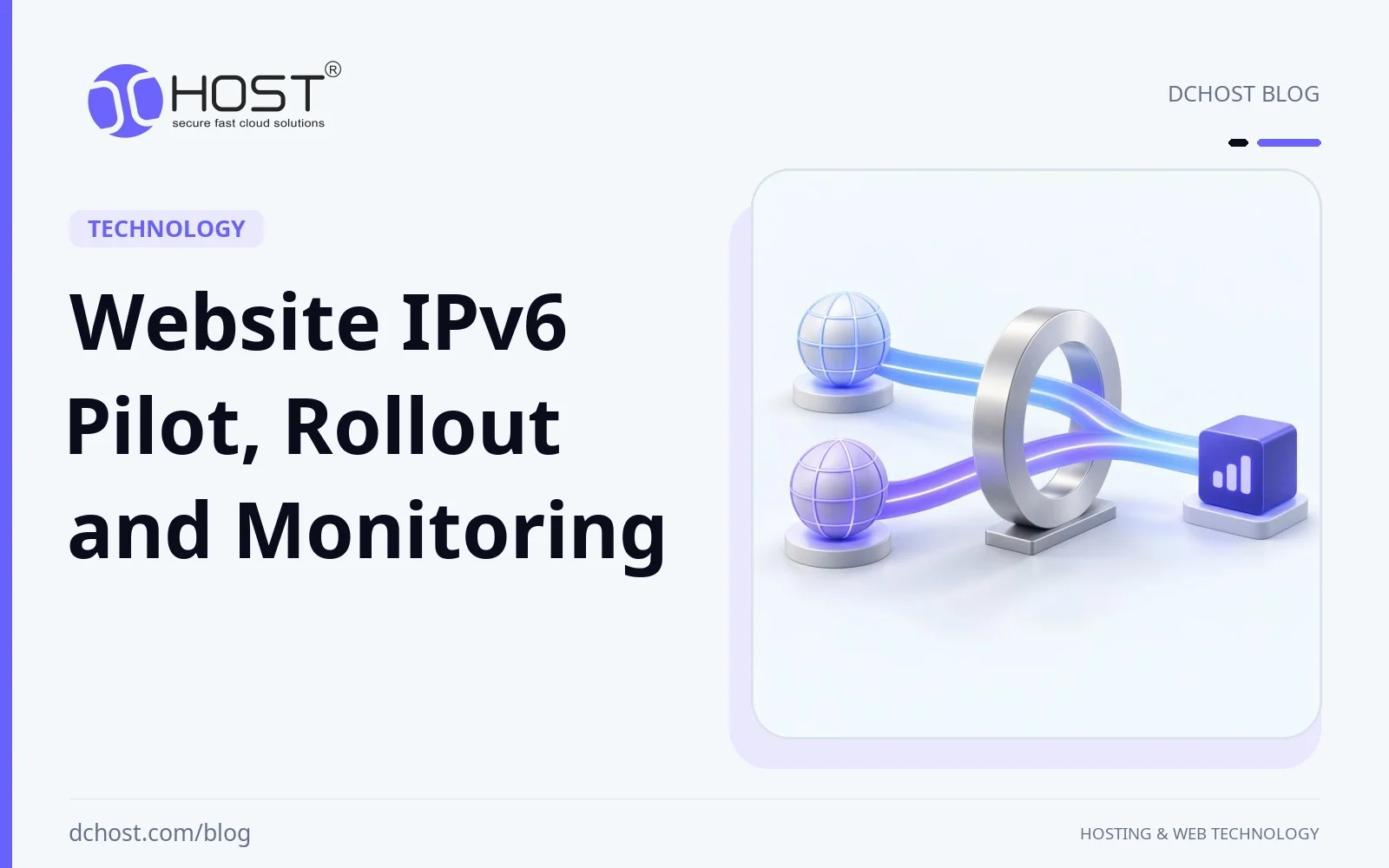
Imagine checking a website dashboard after adding IPv6 and seeing requests arrive over both address families. This is a hypothetical starting point, not a reported customer result. Before treating the new traffic as evidence of success, check what the dashboard measures: visitor-to-CDN traffic may use IPv6 while the CDN reaches the origin over IPv4.
A website IPv6 pilot answers a specific question: does the service work reliably over that path from the networks its users actually use? This guide sets out dependency checks, DNS, TLS, security, monitoring and a shared acceptance record for a controlled rollout. Public adoption measurements provide context; the pilot result comes from your own service tests.
Define the Website Pilot and Its Context
IPv6 becomes usable as access networks and services deploy it. Availability varies by network, country, provider, product and location. Native IPv6 can avoid some IPv4 address-sharing arrangements, but it does not guarantee fewer middleboxes, a shorter route or lower latency. Check the support offered by each service in your own path.
The clear protocol difference is address space: IPv6 uses 128-bit addresses instead of IPv4’s 32 bits. That gives networks more room for address planning. It does not make content better or automatically improve application performance. An address allocation also does not require every service to be publicly accessible; access policy remains a separate decision.
Google’s IPv6 statistics measure the percentage of Google users reaching it over IPv6. APNIC’s measurement dashboard offers another view across networks and countries. Compare scope, date and measurement method before comparing values; neither is your site’s traffic share, and local results or short-term trends need not move in one direction.
For dated comparisons, use the guide to IPv6 adoption measurements, denominators and policy targets. Keep that research separate from the acceptance results for this website.
What Dual-Stack Changes for a Website
Dual-stack offers both IPv4 and IPv6. Clients with working IPv6 connectivity can use it without a separate user action. Many clients use Happy Eyeballs connection attempts across address families to reduce delays when a path fails or is slow. That does not select a universally fastest path or excuse a broken IPv6 deployment; measure both paths explicitly.
The DNS records guide explains A and AAAA: they identify IPv4 and IPv6 addresses respectively. For direct hosting, publish AAAA only after external IPv6 HTTPS tests pass. For a proxied site, follow the CDN’s DNS instructions; publishing the origin address can bypass the intended edge. Client-to-edge and edge-to-origin connections can use different address families.
Test the intended hostname, certificate and application response on each endpoint. Confirm the exact CDN or load-balancer configuration and origin access policy. Missing IPv6 allow rules under an IPv6 default-drop policy can cause timeouts; an IPv4-only rule does not itself match and drop an IPv6 packet. Trace the actual path before changing rules.
Hypothetical Pilot: A Retail Website
Consider a shop with product pages, a cart and checkout. Before publishing IPv6 access, define expected responses for all three flows and choose representative external test networks. Compare connection errors and timing by address family during normal and busy periods. This example does not assume a particular traffic percentage, performance improvement or customer outcome.
If its payment API supports only IPv4, retain the required IPv4 egress while testing dual-stack ingress. Public IPv6 access does not require every downstream integration to migrate at once. Record the dependency, its owner and the condition for revisiting it; do not remove a working route just because the website itself supports IPv6.
Test rate limits and logs before increasing exposure. A per-address limit can behave differently as IPv6 clients use multiple addresses; an overly broad prefix limit can group unrelated users. Combine appropriate network signals with authenticated session and behavioral context, then inspect false positives. Do not claim the change eliminates them without measurements.
Measure Performance by Address Family
Compare connection setup, TLS negotiation, application response and failure rate from representative networks. IPv6 can be faster, similar or slower depending on routing and service placement. It also needs working path MTU discovery; blocking relevant ICMPv6 messages can produce failures that a small request or IPv4-only test misses.
Separate the network path from the application workload and CDN cache state when comparing results. IPv6 visitors do not prove that the origin stopped using NAT, and more addresses do not guarantee better user attribution. Use the observed data to decide whether a deployment change helped your users.
Address-planning benefits apply to infrastructure actually using IPv6. Adding public dual-stack alone does not remove internal RFC1918 dependencies or reduce billed IPv4 assignments. Include retained IPv4, proxy capacity and operational work in the plan. A larger address space is useful, but topology, allocations and dependencies still need documentation.
Apply Security Policy to Both Protocols
IPv6 is a network-layer protocol with its own packet and control-message behavior. It is not inherently a guarantee of weaker or stronger security. Inventory exposed services and apply the intended access policy across IPv4 and IPv6, including the layers that terminate or proxy traffic.
Do not copy IPv4 firewall rules blindly. Preserve required ICMPv6, including Packet Too Big messages used for path MTU discovery, and apply appropriate neighbor-discovery handling at the relevant link and filter location. Test WAF, rate limits, logging and any geolocation dependency for IPv6. Equivalent policy does not mean identical protocol rules.
NAT and firewall policy serve different purposes. For IPv6, explicitly restrict unsolicited inbound access while permitting intended services, necessary responses and required control messages. Verify the result externally. Avoid both blanket ICMPv6 blocking and an assumption that all ICMPv6 should pass every boundary without consideration.
Prepare and Test Before Publishing AAAA
Choose a low-risk pilot and confirm support for the exact hosting product, location and CDN plan. For direct hosting, prepare IPv6 addressing, routing, listener, TLS, firewall rules and monitoring. From an external IPv6 network, test the application using its intended hostname for SNI and certificate validation while targeting the new address. DNS resolution or a local connection alone is insufficient. Publish AAAA only after those tests pass.
With a CDN, follow its documented IPv6 and DNS process and test the client-facing path plus the separate origin path; the origin may remain IPv4-only. Prepare monitoring before exposure. Observe representative user networks and workload periods rather than assuming a day or two is always enough. Compare application failures and protection-rule behavior as well as traffic share.
Expand after the acceptance criteria pass and the rollback route is understood. APIs, static assets, admin endpoints and internal calls have different dependencies; handle them separately. Keep admin access restricted. A critical status service is not automatically a safe first pilot just because it has low traffic.
DNS, Certificates and Renewal Need Separate Checks
For direct hosting, AAAA must point to the tested IPv6 endpoint. For a CDN, use the provider’s intended DNS arrangement. If DNS-based routing or failover is involved, verify A and AAAA behavior, health-check address family and the backup endpoint’s readiness. Working authoritative DNS alone does not prove application availability.
For a hostname-based certificate, the required hostname coverage remains the same across IPv4 and IPv6, but every endpoint must serve the correct certificate. Renewal reachability can change: Let’s Encrypt prefers IPv6 for initial validation when A and AAAA exist, and a wrong response on IPv6 is not simply repaired by a working IPv4 site. Test the chosen challenge path. DNS-01 supports wildcard validation through DNS, but does not itself test the web endpoint’s HTTPS configuration.
The A, AAAA and related DNS records guide is useful when preparing the change. Lower existing TTLs in advance where appropriate and allow the previous TTL interval; the new TTL does not rewrite cached answers. Reverting DNS is not immediate connection rollback, so preserve the required old path while clients and dependencies transition.
Make IPv6 Visible in Logs and Analytics
IPv6 addresses have multiple valid text representations, including compressed forms. Use an IP-aware parser and a consistent canonical representation rather than merely widening an IPv4 regex or splitting on colons. Brackets delimit IPv6 literals in URLs and some address-port syntax; they are not part of every raw address representation. Test the formats your software actually receives.
Check the entire pipeline from proxy to application, collector, database and dashboard for truncation or mis-parsing. Confirm address-family support in reputation or geolocation feeds before relying on them. A source IP is a network identifier, not a dependable one-to-one user identity; use appropriate application context in analysis and protection decisions.
Include APIs and Internal Dependencies
Inventory API gateways, container networks, payment connections, webhooks and any tunnels separately. For each path, record its supported address families, owner, access policy and test result. An IPv6 address plan must fit the allocated prefixes and platform behavior; generous address space does not remove the need for routing or renumbering planning.
Keep IPv4 egress for an IPv4-only integration until a tested alternative exists. A public edge can accept IPv6 while internal services use IPv4. Separate these changes so that a successful visitor path is not mistaken for a completed internal migration. Any performance or maintenance benefit should be established from the actual design.
Treat Email as Its Own Deployment
For inbound IPv6 mail, first verify routing, the mail listener and access rules, then publish AAAA for the hostnames referenced by MX records. Outbound mail also needs correct PTR and matching forward DNS, authentication and recipient acceptance. SPF, DKIM and DMARC remain relevant; test gradual sending and recipient-specific requirements. Confirm the exact sending provider’s support rather than assuming it.
Other services need similarly explicit decisions. Internal databases do not need public exposure merely because IPv6 is available. Admin endpoints still need restricted access and authentication, and public APIs need their own client and dependency tests. Keep inbound and outbound requirements separate in the inventory.
Define Acceptance Before the Change
A successful pilot has working application flows from the required networks, correct certificates, visible per-family failures and tested protection policies. IPv6 traffic share may change without implying success or failure on its own. Compare errors and latency against the chosen baseline and investigate any network-specific regression.
| Field | What to record |
|---|---|
| Scope and owner | Hostname, required user flows, responsible team and rollback operator |
| Connection path | Visitor-to-CDN and CDN-to-origin legs, with IPv4/IPv6 state for each |
| Dependency | Payment, API or webhook owner, retained IPv4 path and condition for revisiting it |
| Test coverage | Representative external networks, normal and busy periods, test time and data source |
| Acceptance and result | Criteria for errors and timing chosen in advance, observed result, open issue and decision |
| Rollback | Previous configuration and access plan for DNS caches and existing connections |
This is a test template, with no measured results or universal numerical thresholds. Set acceptance limits from service requirements before the change. For example, adding IPv6 web ingress does not remove the IPv4 egress dependency of an IPv4-only payment service.
When a test fails, examine DNS targets, routing, listeners, TLS, access rules, MTU behavior and dependencies in path order. Do not assume every symptom has a quick firewall fix. Schedule changes while the responsible team can observe and respond; retain enough diagnostic detail to distinguish a client-path problem from an origin problem.
The Internet Society’s IPv6 deployment resources offer broader context. Use the documentation for your actual network and software when resolving a particular failure. Record what was tested and what remains unverified so the next operator can reproduce the result.
Connect the Rollout to a Business Requirement
Frame the project around supported customer networks, capacity planning and maintainable operations. Identify the service requirement first, then set measurable acceptance criteria and an effort budget. IPv6 alone does not promise more conversions, faster campaigns or uninterrupted releases; those outcomes require evidence from the service itself.
A bounded pilot can also give the team practical experience with address formats, access policy and monitoring. Use a reproducible test plan and document incidents and rollback steps. Training value comes from that work; it is not evidence that a production migration has already succeeded.
Avoid Gaps Between Proxy, Policy and Monitoring
Common checks include preparing the IPv6 endpoint before publishing AAAA, expressing access policy for both families and installing explicit external IPv6 HTTPS probes. Test essential ICMPv6 handling and application response, not just a tiny network packet. Infrastructure objects can help keep policies consistent, but their rendered rules still need inspection.
If a reverse proxy forwards client addresses, configure the application or real-IP module to trust only known proxies and the intended chain. Do not take the first client-supplied X-Forwarded-For value as authoritative. Verify IPv4/IPv6 parsing and trusted-hop behavior so spoofed headers do not control logs, allowlists or rate limits.
Start with a Bounded Pilot
A test or documentation subdomain with representative traffic may be suitable. Prepare addressing, routing, TLS, access controls and monitoring, then test externally before publishing its AAAA or applying the CDN’s documented access change. For a proxy, verify client-to-edge and edge-to-origin independently; origin IPv6 is required only if that leg is configured to use it. Expand when the planned coverage passes.
Audit the resulting firewall/WAF behavior, log pipeline and authorized administrative access. Add only approved IPv6 sources to allowlists; do not broaden access just to make a failing test pass. Record the previous configuration and the DNS/cache implications of rollback before the production change.
Use the Results to Choose the Next Service
The hypothetical dashboard at the start is only one observation. Completion requires tested connectivity, correct TLS, successful application flows, visible failures and an actionable rollback plan. Keep the preparation order consistent: configure and instrument the path, verify it externally, then publish access.
After the pilot, compare the results with the requirements and expand deliberately. Keep necessary IPv4 paths until their dependencies have a verified alternative. Treat speed, address savings and operational simplicity as separate outcomes to measure, rather than automatic consequences of an AAAA record.
The Internet Society’s IPv6 resources can support the next planning step. Keep the local test record alongside wider adoption measurements, since they answer different questions: what is happening across networks, and whether your own service works for the users it must reach.